The Fed Holds, but the Dot Plot Reveals a Hawkish Shift
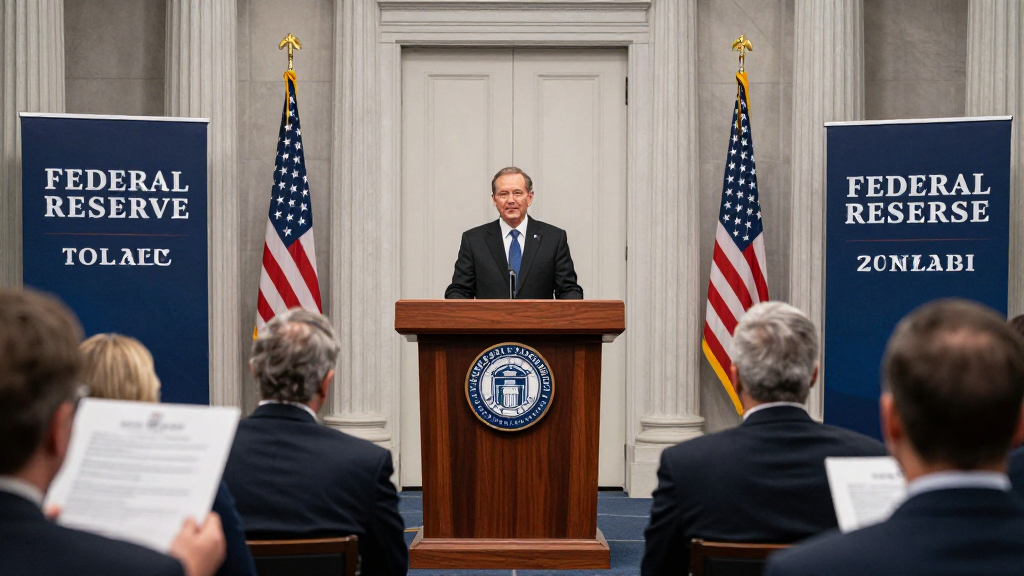
The Federal Reserve held interest rates steady on Wednesday in its first major policy decision under new chair Kevin Warsh, but the accompanying economic projections delivered a hawkish surprise that sent markets reeling and deepened uncertainty about the direction of monetary policy. The Federal Open Market Committee voted 12-0 to maintain the benchmark federal funds rate in a target range of 3.50 to 3.75 percent, a decision that aligned with the 99 percent probability priced in by CME FedWatch traders heading into the meeting. Yet the Summary of Economic Projections showed that nine of the 19 officials on the committee now favor a rate hike before year-end, a sharp reversal from the dovish tilt of the March forecast when only a handful of officials were penciling in increases. Six of those nine officials support two quarter-point increases, signaling that the central bank is preparing to tighten aggressively if inflation does not begin to recede from its current 4.2 percent plateau. The gap between the unanimous hold decision and the aggressively tilted dot plot rattled investors, sending US equity indices lower as they digested the implications of a potentially steeper rate path heading into the final quarter of 2026.
Inflation at a Three-Year High as Energy Prices Surge
The Fed’s dilemma is rooted in a surge in consumer prices that has undone much of the disinflationary progress achieved in 2024 and early 2025. Last week’s consumer price index report from the US Department of Labor showed that inflation climbed to 4.2 percent annually in May 2026, the highest reading since early 2023, with energy prices jumping 23.5 percent on the month as the US-Israel war with Iran disrupted refining capacity and shipping routes across the Persian Gulf. The conflict has introduced a geopolitical risk premium into global energy markets that conventional monetary policy tools struggle to offset through interest rate adjustments alone. “Persistently high prices are a burden for the American people,” Warsh said at his inaugural press conference. “But the recent past need not be prologue. I am pleased to report that members of the FOMC are unambiguous and unanimous. This committee will deliver price stability.” Even as reports of a potential US-Iran peace agreement pushed Brent crude to a three-month low earlier this week, supply chain disruptions, production halts, and depleted strategic stockpiles compiled during months of hostilities mean consumers could face elevated prices for several more months before any meaningful relief materializes at the pump or in household energy bills.
The Independence Question Looms Over Warsh’s First Meeting
Warsh’s debut as Fed chair arrives shadowed by political scrutiny that has no modern precedent. President Donald Trump, who selected Warsh to succeed Jerome Powell, made clear before the appointment that he expected the central bank to begin cutting rates and criticized the Fed for maintaining excessively restrictive monetary conditions throughout 2025. Yet with inflation now running at more than twice the Fed’s 2 percent target, Trump has pivoted, telling NBC’s Meet the Press that there is “no reason” to raise rates and praising Warsh effusively in the same interview. The apparent alignment between the White House and the new chair has set off alarm bells among economists who view the Fed’s institutional independence as foundational to its credibility and its ability to control inflation expectations. “Even if Warsh feels beholden to the Trump administration, an overtly dovish tone would reignite concerns about Fed independence and risk pushing up long-end bond yields, which could inadvertently raise borrowing costs across the entire economy,” said Stephen Brown, chief economist for North America at Capital Economics, in a client note distributed after the decision. Brown added that a politically sympathetic Warsh would still need to “toe the line between sounding neutral and acknowledging that hikes are a possibility,” a balance that will become increasingly difficult to maintain if inflation remains elevated through the summer. Yerbol Orynbayev, a former World Bank governor, was blunter in remarks provided to Al Jazeera. “Warsh’s choosing to wait and see will have been almost inevitable and will have little impact on doubts about his independence,” Orynbayev said. “Rate cuts would have been reckless given current economic conditions, but hikes were similarly unlikely, given the resilient labor market and the very recent shift in geopolitics.” The tension between the executive branch and the central bank’s independent mandate has become one of the defining macroeconomic battles of 2026, and Warsh’s next FOMC meeting in September will be scrutinized as much for its political subtext as for its economic substance.