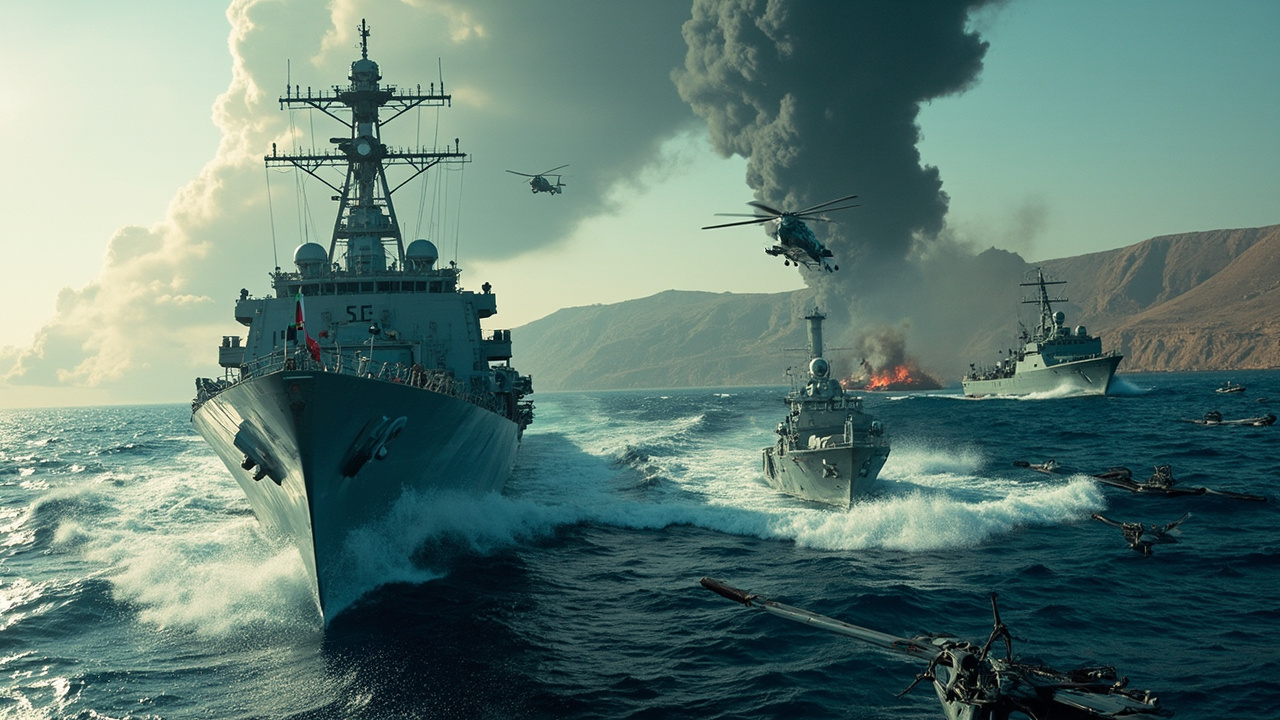
Iran launched drone attacks targeting Bahrain on Saturday, officials confirmed, marking the most significant escalation in the Strait of Hormuz since the collapse of ceasefire negotiations earlier this week. Bahrain’s Interior Ministry said its air defence forces intercepted multiple unmanned aerial vehicles overnight, though fragments landed in residential areas of Manama causing minor damage and no casualties. Separately, a commercial tanker was struck in the Strait of Hormuz, the fifth such incident in eleven days, according to the US Naval Institute’s conflict-tracking database.
Ceasefire Collapses Amid Escalating Retaliation
The attacks came 48 hours after US President Donald Trump ordered precision strikes against Iranian radar and missile installations in retaliation for what the White House described as an Iranian drone violation of the fragile ceasefire covering Gulf shipping lanes. Trump’s administration had granted Iran a 60-day partial sanctions relief window in exchange for Tehran’s commitment to halt attacks on vessels transiting the strait, a corridor through which roughly 20 percent of the world’s oil supply passes.
“The Iranian regime has once again demonstrated that it cannot be trusted to honour its commitments,” US Secretary of State Marco Rubio said in a statement Saturday. “The United States will respond proportionately to every violation, and we expect our allies in the region to do the same.”
Bahrain Drawn Into Broader Regional Confrontation
Bahrain, which hosts the US Fifth Fleet’s headquarters at Mina Salman port, has been increasingly drawn into the confrontation. Iranian state media described the Bahrain attacks as “retaliatory precision strikes” in response to what it called US incursions into Iranian airspace over the Gulf. Bahrain’s government rejected that characterisation and called for an emergency session of the Gulf Cooperation Council.
British Foreign Secretary David Cameron spoke with Bahrain’s Crown Prince on Saturday and offered British naval support for convoy operations through the strait. “Freedom of navigation is not negotiable,” Cameron said in a post on social media. “We will not allow the Strait of Hormuz to become a theatre of unchallenged intimidation.”
Oil Markets React as Shipping Companies Reroute
Brent crude rose 3.8 percent to $94.20 a barrel in early London trading on news of the tanker strike, extending a weeks-long rally driven by geopolitical risk premiums. Lloyd’s of London, the insurance market, issued a notice advising members that premiums for vessels transiting the Strait of Hormuz would increase by up to 40 percent effective immediately. Three major shipping companies — MSC, Maersk and CMA CGM — announced they were rerouting vessels around the Cape of Good Hope, adding an estimated 14 days to transit times and significantly increasing freight costs. The detour eliminates passage through the strait entirely but raises operational costs substantially for container ships carrying consumer goods between Asia and Europe.
“The insurance and rerouting costs are already being passed on to importers and, ultimately, consumers,” said Amrita Sen, director of research at Energy Aspects in London. “A prolonged closure of even a section of the strait would be deeply inflationary for global trade.”
Diplomatic Channels Remain Open Despite Tensions
Despite the uptick in hostilities, diplomatic channels remain technically open. Oman’s Sultan Haitham bin Tariq hosted separate calls with the US special envoy for Iran and Tehran’s deputy foreign minister on Friday, Muscat’s foreign ministry confirmed. Qatar’s Emir also held conversations with both Washington and Tehran in the past 72 hours, according to a statement from Doha’s government communication office.
International Atomic Energy Agency Director General Rafael Grossi arrived in Tehran on Saturday for talks on resumption of monitoring inspections at Iranian nuclear sites, the agency said in a statement. The visit comes as the Trump administration has threatened to withdraw from the nuclear Non-Proliferation Treaty if Iran resumes enrichment at weapons-grade levels.
What Comes Next
US defence officials said the Pentagon was reviewing options for enhanced maritime security operations in the Gulf, including the potential deployment of additional carrier groups. Any such deployment would require several weeks of logistical preparation and would likely be framed as a defensive posture, according to two officials briefed on the discussions who were not authorised to discuss them publicly.
Iran’s parliament is scheduled to convene an extraordinary session on Sunday to debate the government’s response to US sanctions, Iranian state media reported. Hardliner factions have called for a complete withdrawal from the nuclear Non-Proliferation Treaty, a step that would be largely symbolic but would further isolate Tehran diplomatically.
Oil traders and maritime insurers will be watching the coming 72 hours closely for signs of whether the Hormuz attacks represent a calibrated pressure tactic by Iran or the opening phase of a broader military campaign. The outcome will determine whether the diplomatic back channels can hold — or whether the strait that moves a fifth of the world’s oil becomes the next theatre of open conflict.
The UN Security Council is tentatively scheduled to receive a briefing on the escalation on Wednesday, according to a senior UN official. World leaders have called on both sides to return to the negotiating table before the situation becomes irreversible.