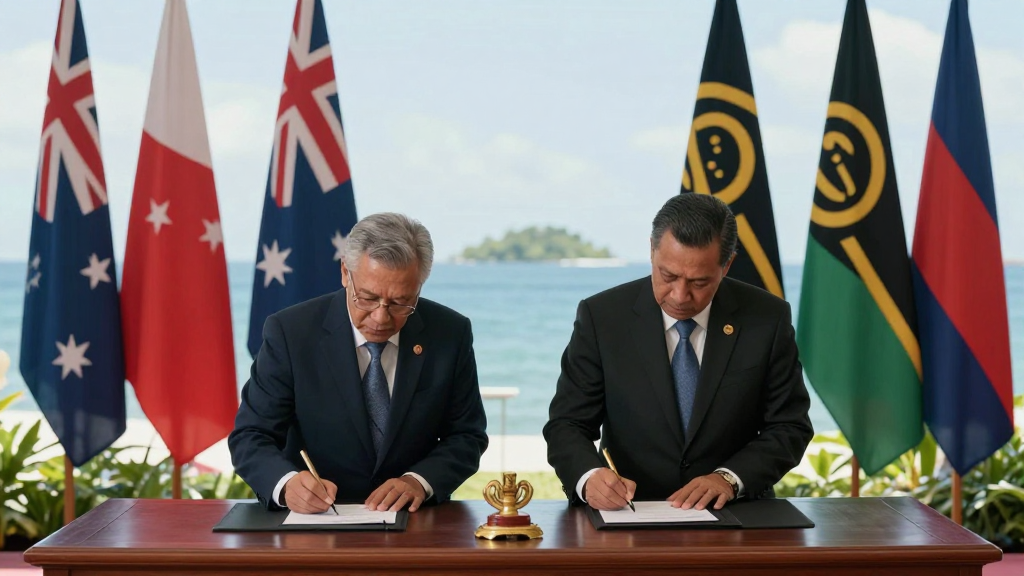
Australia and Vanuatu signed a landmark security agreement on June 29 that explicitly blocks either nation from hosting foreign military bases on Vanuatu’s territory, in a move widely interpreted as a direct rebuff to China’s years-long campaign to establish a strategic foothold in the Pacific islands region. The Nakamal Agreement, signed in Port Vila by Prime Minister Jotham Napat and Australian Prime Minister Anthony Albanese, represents the most significant security agreement Vanuatu has signed with any partner in more than a decade and signals a decisive shift in the archipelago’s strategic alignment.
Vanuatu and Australia Sign Historic Security Pact
Albanese described the agreement as “a new chapter in our security partnership” rooted in mutual respect and shared regional stability. The pact notably contains explicit language prohibiting foreign military installations on Vanuatu’s islands, a clause that senior Australian defence officials said was specifically designed to foreclose the possibility of a Chinese naval or coast guard resupply facility. Napat said the agreement reflected Vanuatu’s “independent foreign policy” and its right to choose its own partners without external pressure or coercion.
The intelligence backdrop to the deal is significant. Australian defence and intelligence assessments have concluded that Chinese officials approached Vanuatu on at least four separate occasions between 2022 and 2025 seeking agreements that would have granted the People’s Liberation Army Navy access to Port Vila or other Vanuatu harbours. Each approach was rebuffed at the working level before reaching formal negotiation. Australian officials kept their US counterparts informed throughout the process, and the eventual Nakamal Agreement was shared with Washington before its formal signing.
China’s Pacific Influence Campaign Meets Resistance
Beijing’s Pacific push accelerated sharply after the 2022 Solomon Islands security pact with China — a deal that gave Beijing its first actual security foothold in the Pacific and triggered alarm bells across Canberra, Wellington, and Washington. In the Solomon Islands, Chinese police have since trained local forces under the terms of that agreement. A Chinese-funded port expansion at Hanavadu on the island of Tanna has prompted Australian and US concern about dual-use civilian-military infrastructure that could eventually accommodate naval vessels. The Nakamal Agreement is the most concrete pushback so far from a Pacific island nation against Chinese security overtures of this kind.
China’s Foreign Ministry dismissed the agreement as reflecting a “Cold War mentality” and warned it could destabilise the region. “We oppose the creation of exclusive military blocs in the Pacific and any attempt to regional peace through containment or encirclement,” a ministry spokesperson said in Beijing. Chinese state media was more blunt, publishing an editorial that accused Australia of using Vanuatu as “a pawn” in its strategic competition with China and warning that the agreement could “poison” broader Pacific regional relations.
South China Sea Flashpoints and the Widening Regional Architecture
The Vanuatu announcement landed alongside escalating confrontations in the South China Sea, where Philippine coast guard vessels at Sabina Shoal and Scarborough Shoal have faced aggressive Chinese water cannon use, laser illumination, and ramming incidents in successive weeks. The US formally reaffirmed its mutual defence commitments with the Philippines, invoking Article 5 of the 1951 Mutual Defence Treaty for Philippine coast guard ships for the first time under the expanded treaty protocol signed in April. The move was interpreted in Manila as a significant deterrence signal to Beijing.
Japan and the Philippines formalised their Reciprocal Access Agreement in Manila in February, enabling seamless joint military exercises, port calls, and intelligence sharing. Japan’s Self-Defence Forces are systematically expanding their operational reach across the first island chain, with senior defence officials in Tokyo describing the regional architecture as “a rules-based order that must not be eroded by unilateral coercion.” Vietnam and Malaysia simultaneously pressed for a South China Sea code of conduct that would explicitly exclude their own disputed maritime claims from its scope — a position that complicates ASEAN’s already fragile unity on the issue.
Australia has indicated it will station dedicated defence attachés in Port Vila under the Nakamal framework, and senior US defence officials have been briefed on the agreement’s design and strategic rationale. The combined effect of the Vanuatu pact, the expanded US-Philippines mutual defence treaty, and Japan’s deepening Pacific engagement constitutes the most consequential realignment of regional security architecture since the Cold War ended. The question now is whether Beijing responds with diplomatic pressure, economic leverage, or a show of military force in the South China Sea — or some combination of all three.