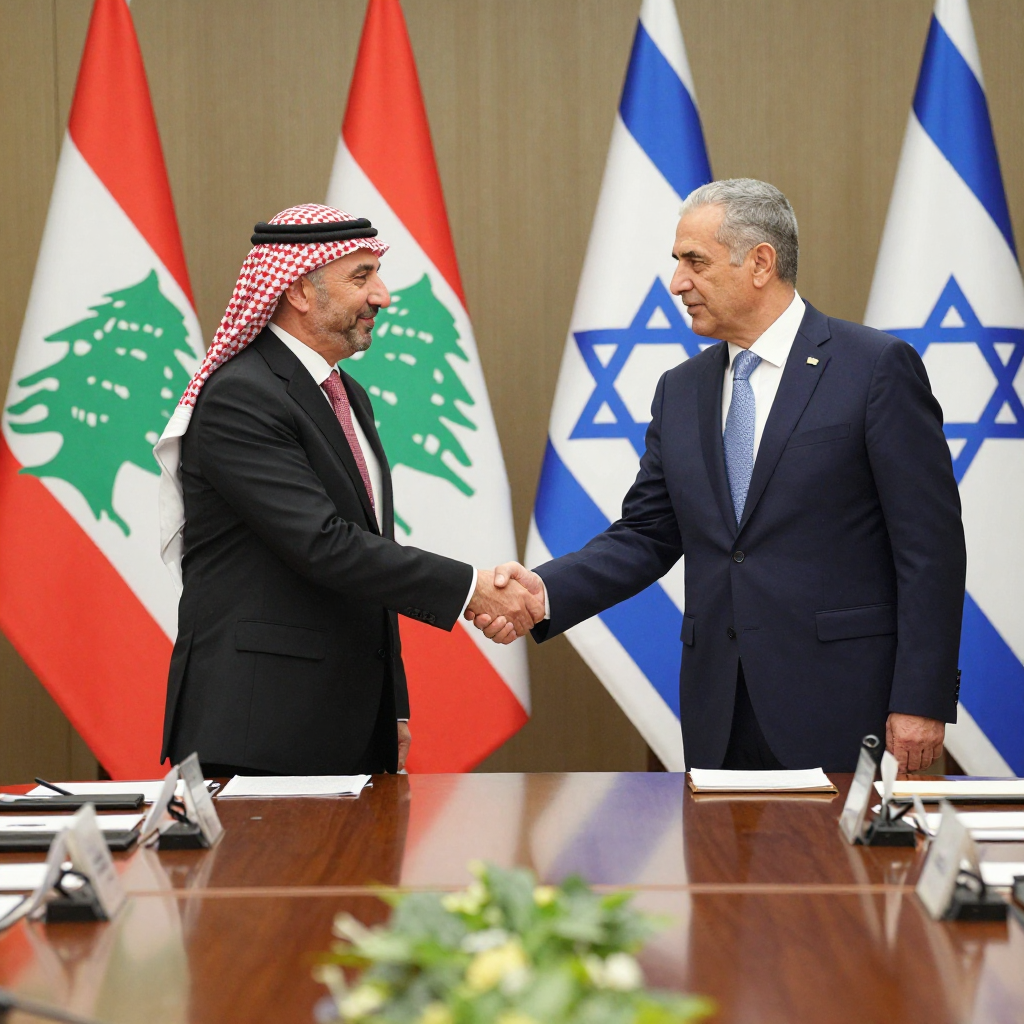
Israel and Lebanon signed a framework peace agreement on Thursday, with United States Secretary of State Marco Rubio announcing the deal from the Vatican and releasing the full text of the accord. The agreement, mediated by Washington after months of quiet diplomacy, calls on Hezbollah to cease all attacks and begin a phased disarmament process in exchange for Lebanese government guarantees and international monitoring. Rubio described the framework as a “first step” toward a lasting settlement in the region.
The announcement marked the most significant diplomatic breakthrough in the Levant since the 2023 Gaza conflict escalated into a broader regional war. Rubio flew to the Vatican after departing the G7 summit in Taormina, Italy, where he had clashed with European allies over how to handle Iran negotiations running in parallel. He said the United States would work with both governments to implement the terms over the coming weeks.
Framework Terms and Ceasefire Architecture
The agreement, dated June 25, 2026, establishes a monitored ceasefire line along the Blue Line buffer zone and lays out a three-phase process for Hezbollah’s disarmament, according to the text released by the State Department. Phase one requires Hezbollah to surrender heavy weapons and vacate positions within 60 days. Phase two transfers border security to the Lebanese Armed Forces under United Nations supervision. Phase three envisions a long-term international monitoring mechanism involving France, the United Nations, and the European Union.
“The people of Israel deserve to live in peace and security, and this framework offers a credible path toward that goal,” Rubio said in a statement. “Equally, the Lebanese people deserve a sovereign state free from the grip of a foreign-backed militia.”
Lebanon’s caretaker Prime Minister Najib Mikati welcomed the accord but said parliamentary approval would be required before any binding commitments were made. Hezbollah officials have not issued a formal response as of Thursday evening. The group’s deputy leader, Sheikh Nabil Kaouk, told Al Jazeera the group had not been consulted and called the announcement “a unilateral American initiative that ignores the realities on the ground.”
Regional Reactions and Implementation Risks
The agreement immediately drew contrasting reactions from regional powers. Iran, which has long armed and funded Hezbollah, issued a statement through its foreign ministry calling the deal “a Western-imposed framework that undermines Lebanese sovereignty.” The statement did not threaten military action but said Tehran would “watch closely” as events unfolded. Iranian officials have previously warned that any attempt to disarm Hezbollah by force would trigger a broader regional response.
Jordan and Egypt issued a joint communiqué expressing cautious support, with Cairo adding that the timing would need to be synchronized with progress in Gaza ceasefire talks to avoid creating a security vacuum that could benefit extremist groups. The two Arab states have been mediators between Israel and Hamas for months and fear a separate Israeli-Hezbollah settlement could undermine those efforts.
European Union foreign policy chief Kaja Kallas said the bloc stood ready to deploy monitors and economic support for Lebanon, contingent on both parties fulfilling their obligations under the framework.
“This framework represents a genuine opportunity, but opportunity is not certainty,” Kallas told reporters in Brussels. “The EU will judge this agreement by what is implemented on the ground, not by what is written on paper.”
Diplomatic Momentum and What Comes Next
The announcement came at the close of a fractious G7 summit where major powers had clashed over how to handle Iran policy. The United States had pushed for the communiqué to acknowledge the Israel-Lebanon framework as a model for broader Middle East diplomacy, while France and Germany insisted any mention be conditioned on IAEA verification of Iran’s nuclear programme. The final text included language “taking note” of the framework without explicitly endorsing it, reflecting the persistent transatlantic divide.
Diplomats told Reuters that Rubio’s decision to announce from the Vatican rather than from the G7 podium underscored how much the deal depended on bilateral channels rather than multilateral consensus. The Vatican, which maintains diplomatic relations with both Israel and Lebanon, provided a venue that avoided the appearance of a Western-imposed settlement.
Analysts warned that implementation remained the central challenge. Hezbollah has historically resisted disarmament demands, and the group’s military wing retains significant independent capacity. Israeli officials have said they will not tolerate delays beyond the 60-day window, raising the prospect of resumed hostilities if milestones are missed. The Israeli military said it would “reserve the right to act” if the agreement broke down.
The United Nations Interim Force in Lebanon said it had received no formal briefing on the agreement and would await instruction from headquarters in New York. Secretary-General António Guterres called on all parties to exercise maximum restraint and said the UN was ready to support implementation if requested by both governments.