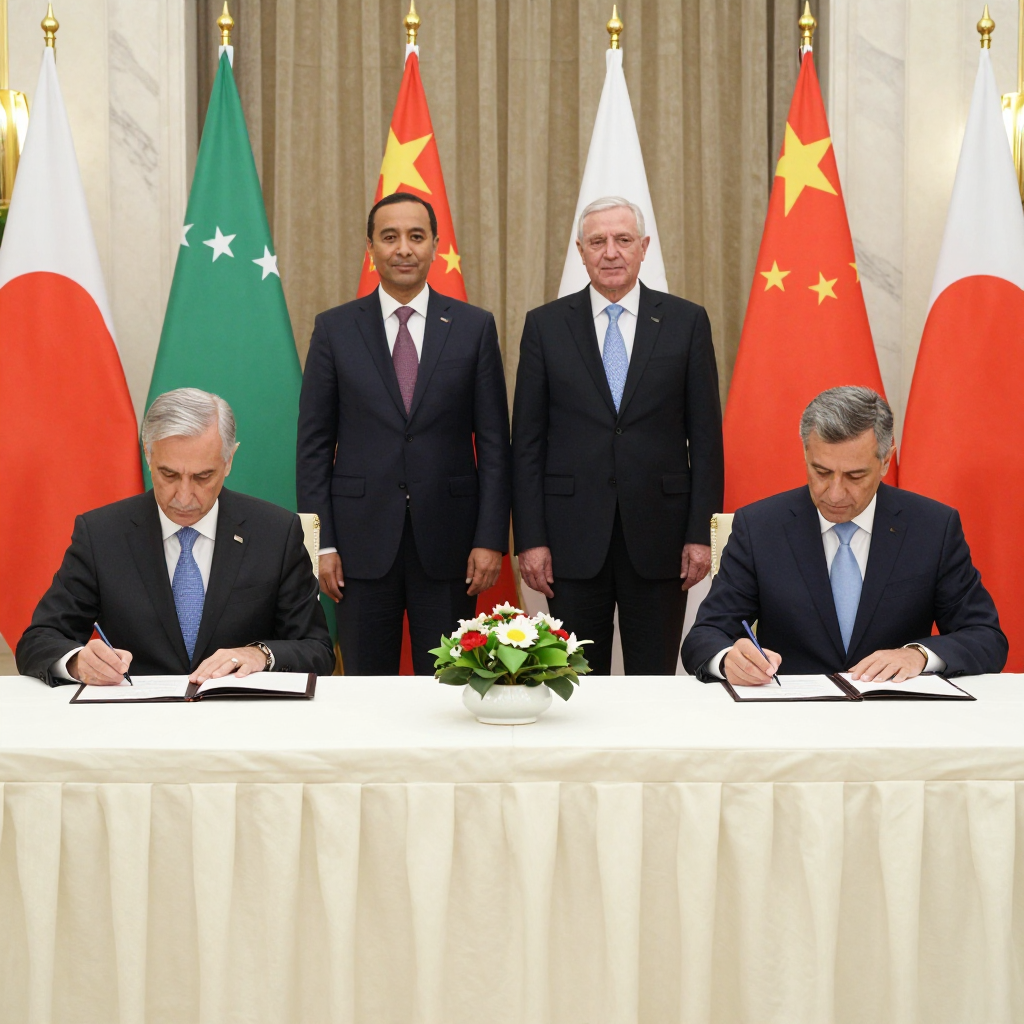
Israel and Lebanon signed a landmark framework agreement on Thursday, brokered by the United States, that sets out a process for Hezbollah to surrender its weapons in exchange for a verified ceasefire along their shared border. Secretary of State Marco Rubio announced the deal from the White House Rose Garden, calling it a “first step” toward lasting peace in the region after more than nineteen months of hostilities that had displaced tens of thousands of civilians on both sides and brought the eastern Mediterranean coastline to the brink of wider war.
The agreement, a joint statement endorsed by all three governments, requires Hezbollah to begin surrendering precision-guided missiles and portable anti-aircraft systems within 60 days of signing. Lebanon’s army, backed by international monitors from a U.S.-led coalition, would take formal control of southern Lebanese territory currently held by the militant group. Israel agreed to a reciprocal withdrawal from several border villages it has occupied since October 2024, returning them to Lebanese state authority pending certification that Hezbollah forces have departed.
Ceasefire Collapse Follows Fifteen Months of War
The framework emerges against the backdrop of a wider regional conflict that has shown no signs of abating. Israel has been engaged in a sustained air and ground campaign against Iranian-linked forces across Lebanon and Syria since October 2024, following the Hamas attack on southern Israel on October 7, 2023, that triggered the broader Middle Eastern war. Rubio acknowledged that while the Lebanon track had improved significantly, the conflict with Iran remained unresolved and that the United States would not hesitate to use military force to protect its personnel and regional interests.
“We have achieved something real today between Israel and Lebanon,” Rubio told reporters. “But the work is not finished. Iran’s aggression continues across the region, and the administration will respond with every tool available to protect American interests and our allies.”
The deal contains an emergency consultation clause that allows either party to summon Washington-backed monitors within 48 hours if violations are detected during the implementation phase. A team of twelve U.S. military observers is slated to deploy immediately to oversee compliance along the Blue Line, the United Nations-drawn demarcation separating Israeli and Lebanese territory that has served as a flashpoint for violence since the 2006 war.
Lebanese Political Factions React With Caution
Lebanon’s caretaker Prime Minister Najib Mikati welcomed the agreement in a televised address from Beirut, saying the framework offered his war-exhausted nation a genuine opportunity to restore sovereignty over its southern regions without further bloodshed. Parliament Speaker Nabih Berri, who served as a back-channel intermediary conveying messages between Hezbollah leadership and U.S. diplomats over several months, called the signing a difficult but necessary compromise that reflected the grim realities on the ground.
Hezbollah itself has not issued a public statement confirming its acceptance of the disarmament terms. Analysts cautioned that the group’s internal deliberations remained opaque, and any sign of defiance from senior commanders could undermine implementation before the 60-day clock formally begins. The organization retains deep political influence in Lebanon’s confessional power-sharing system and commands a network of tens of thousands of armed fighters embedded across the country’s south, the Bekaa Valley, and southern suburbs of Beirut.
Israel’s Security Cabinet approved the framework by a vote of 12 to 4, with dissenting ministers arguing that the terms did not go far enough to permanently neutralize the Hezbollah threat. Prime Minister Benjamin Netanyahu struck a measured public tone, praising the Trump administration’s diplomatic tenacity while making clear that Israel reserved the unilateral right to respond with force if the agreement broke down or if Hezbollah attempted to rearm during the implementation window.
Diplomatic Momentum and the Road Ahead
Thursday’s announcement marks the most significant diplomatic breakthrough in the Middle East since the original Gaza ceasefire collapsed in early 2026, plunging the region into the spiral of violence that has continued to this day. Senior officials from Egypt, Qatar and the European Union rushed to issue statements praising Rubio’s sustained personal diplomacy, noting that Washington had managed to hold together a fragile international coalition bridging both Israeli and Arab interests at the same table.
European Union foreign policy chief Kaja Kallas said the bloc stood ready to fund Lebanon’s new border monitoring institutions and had already begun coordinating with international financial institutions to unlock reconstruction assistance for the country’s war-ravaged south. The Lebanese economy, already struggling with a prolonged financial crisis that predated the current conflict, has seen its currency lose nearly 40 percent of its value since hostilities escalated in late 2024.
The 60-day countdown to weapons surrender formally begins on Friday, with international monitors from the United Nations Interim Force in Lebanon and a U.S.-led liaison team preparing to deploy along the Blue Line. Rubio told reporters he expected the process to proceed in good faith, while acknowledging that prior agreements with Hezbollah had foundered when implementation began on the ground. The true test of the framework will come in the weeks ahead as armed groups begin transferring weapons depots and fortified positions shift accordingly under international supervision.