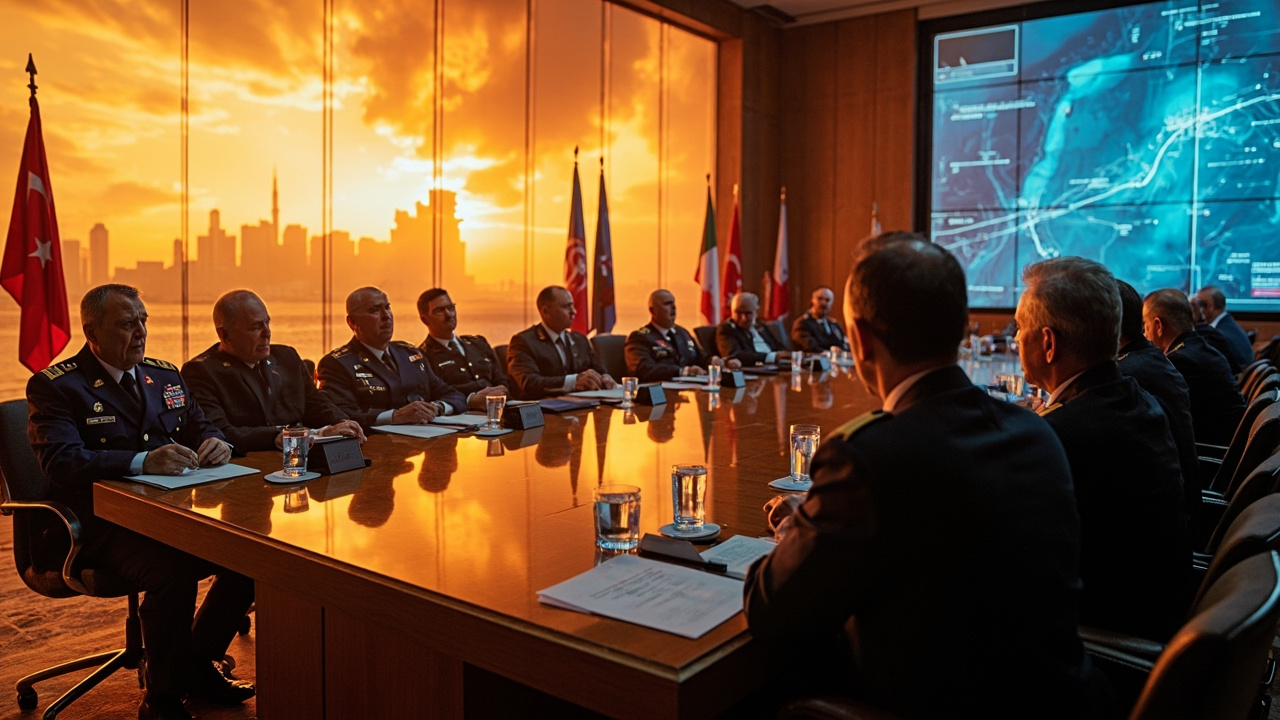
NATO leaders gathered in Ankara on Tuesday for an emergency summit convened to address the dual crises reshaping the alliance’s strategic landscape: Iran’s closure of the Strait of Hormuz and the escalating security implications of climate-driven extreme weather across member states. Turkish President Recep Tayyip Erdoğan convened the meeting at the scale of his government building, with Secretary General Mark Rutte and senior envoys from all 32 member states in attendance for what officials described as the most consequential Ankara session in years.
The Hormuz closure dominated the agenda from the outset. Iran’s Revolutionary Guard Corps sealed the strait’s southern channel on Monday, halting roughly 20 percent of the world’s oil shipments and triggering an immediate spike in global energy prices. The move followed the collapse of indirect US-Iran nuclear talks in Doha and represented the most significant provocation in the Gulf since Iranian forces briefly seized commercial vessels in 2019. NATO’s maritime commanders convened an emergency session to assess escort protocols for allied shipping, while the United States repositioned the USS Dwight D. Eisenhower carrier strike group to the Gulf of Oman.
Hormuz Closure Forces NATO to Rethink Eastern Flank Logistics
Senior alliance officials told Reuters that the closure had immediately complicated NATO’s northern flank resupply routes, forcing planners to reroute equipment convoys through the Suez Canal and around the Cape of Good Hope — journeys that added weeks to delivery schedules. The disruption arrived at an awkward moment: alliance defense ministers had finalised the new Baltic defence plans only days earlier, and pre-positioned ammunition stocks in Poland and the Baltic states were already running below targeted levels after months of supplying Ukraine.
“We are watching the Hormuz situation with real concern,” NATO Secretary General Mark Rutte told reporters at the summit venue. “Any sustained disruption to Gulf shipping will have cascading effects on our ability to sustain operations on NATO’s eastern flank. We are in close contact with the United States, the United Kingdom and our Gulf partners.”
The economic fallout was immediate. Brent crude surged past $98 per barrel on Tuesday morning, the highest level since 2023, after the Hormuz closure was confirmed. European gas prices rose sharply on the benchmark TTF hub in Amsterdam, compounding pressure on households already grappling with the economic aftershocks of the European heatwave that had killed more than 1,300 people the previous week. NATO’s energy security directorate convened a separate emergency session to assess the knock-on effects on alliance defence manufacturing costs.
Climate Security Takes a Formal Seat at NATO’s Table
For the first time in the alliance’s history, a dedicated climate and security session appeared on the formal summit agenda alongside traditional hard-security items. The shift reflected a growing consensus among member states that extreme weather events were increasingly intertwined with the threat landscape the alliance was designed to address. The European heatwave, which saw temperatures exceed 40 degrees Celsius across France, Germany and the Balkans, had killed more than 1,300 people and forced the evacuation of several military installations in southern Europe.
General Christopher G. Culy, NATO’s senior climate adviser, briefed leaders on a classified assessment linking the heatwave’s intensity directly to observable climate trends. “This is not a future scenario,” a senior official who attended the briefing told the Associated Press on condition of anonymity. “Our bases in southern Europe were partially non-operational for 72 hours. That has implications for Article 5 collective defence obligations.”
The assessment added urgency to a draft framework that NATO’s climate action committee had been developing for more than two years. The framework, expected to be formally adopted at the summit’s closing session, would require all 32 member states to incorporate climate risk assessments into their annual defence planning reviews — a first for the alliance. Several eastern European members had initially resisted the measure as outside NATO’s core mandate, but officials said the Hormuz crisis had shifted the calculus considerably.
Alliance Cohesion Tested as Members Weigh Competing Priorities
The Ankara summit exposed fault lines that alliance diplomats had been managing quietly for months. The United States, focused on the Pacific and seeking a negotiated stand-down with Iran, pressed fellow members to avoid any language that could be read as escalatory toward Tehran. European members with significant Gulf energy exposure — Germany, Italy and the Netherlands in particular — pushed for a stronger statement on freedom of navigation, while Turkey, which maintains independent channels with both Tehran and Washington, sought to position itself as a mediating broker.
Hungary’s prime minister, Viktor Orbán, caused a brief commotion when he arrived late to the opening session and publicly questioned whether NATO should be involved in what he called “American conflicts in the Persian Gulf.” His comments drew a sharp rebuke from the Polish and Baltic delegations and briefly threatened to fracture the communique’s opening paragraphs. A compromise was reached that preserved the alliance’s language on freedom of navigation while noting that operational responses remained a national prerogative.
French President Emmanuel Macron, arriving from the G7 in Paris, used a bilateral meeting with Rutte to push for the communique to include a renewed commitment to the NATO-Ukraine council and a reference to “strategic reciprocity” in relations with Russia. The French position was broadly supported by Germany and the Nordic states but faced resistance from Hungary and, more quietly, from Slovakia. The final wording of the Ukraine paragraph was left to a working group that continued deliberating past the summit’s formal closing ceremony.
As the second day of talks began, the immediate focus remained on Hormuz. The White House confirmed that direct communications between US and Iranian officials had resumed through Swiss intermediaries, though both sides described the channel as exploratory rather than substantive. NATO officials said they were preparing contingency plans for a closure lasting up to 90 days — a scenario that one senior planner described to AFP as “the stress test we always knew we would eventually face.”
The Ankara summit was expected to conclude with a formal declaration reaffirming the alliance’s commitment to collective defence, a new climate-security framework and a statement calling for the reopening of Hormuz under existing international maritime law. The document would carry the signatures of all 32 leaders, though the depth of their agreement on how to achieve that reopening remained, in the assessment of one senior diplomat, “a work very much in progress.”