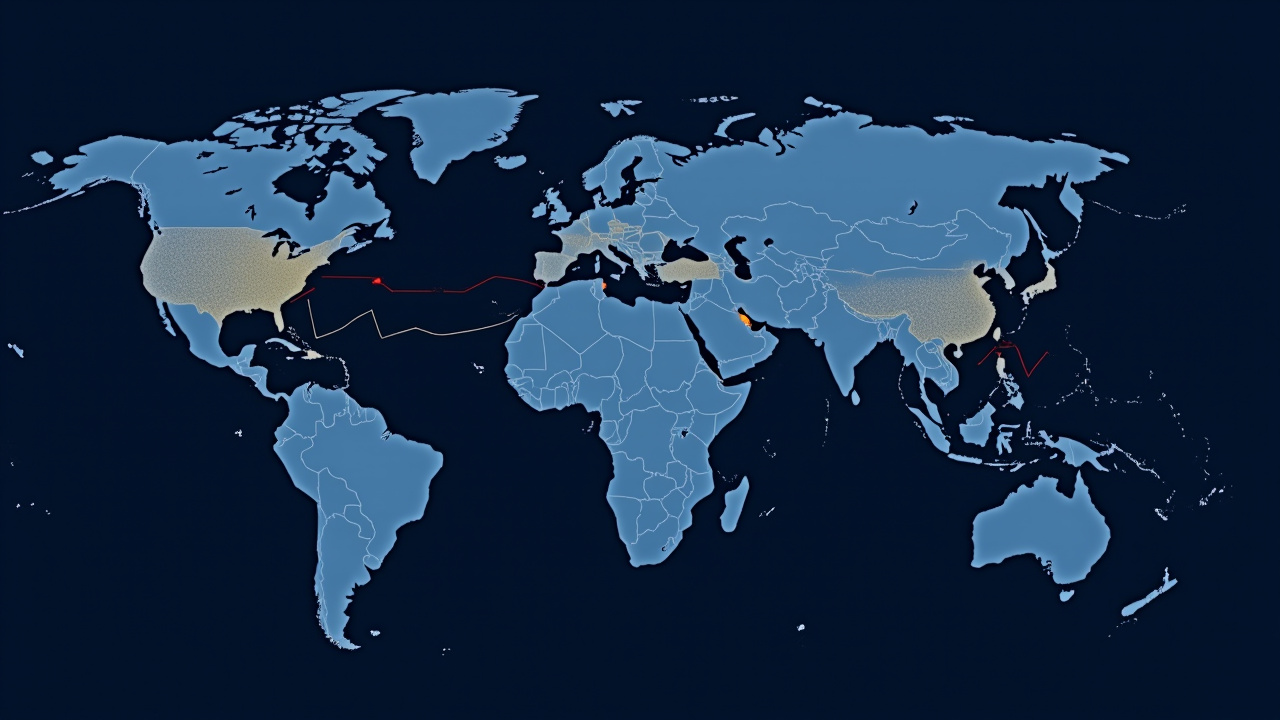
The International Monetary Fund has delivered one of its starkest assessments in years: the global economy is slowing, and the fault lines are multiplying. As policymakers gather in Washington for the IMF/World Bank Spring Meetings, the April 2026 World Economic Outlook offers little comfort — a downgrade to 3.1% global growth, down from 3.4% in 2025, wrapped in language that is as cautious as it is candid. The title of the report says it all: Global Economy in the Shadow of War.
The revision is not merely a technical adjustment. It reflects a fundamental shift in the macroeconomic landscape — one where geopolitical risk has moved from the periphery to the center of economic planning. Wars, trade wars, and the fiscal strain of military buildup are no longer tail risks to be discounted. They are the baseline scenario.
The Numbers Behind the Downgrade
The IMF’s 3.1% growth projection for 2026 represents a meaningful step down from the post-pandemic recovery norms of recent years. But the headline figure obscures a more troubling picture when examined closely. The fund’s report presents three distinct scenarios — a base case assuming a limited Middle East conflict that fades by mid-2026, a worse case in which hostilities expand or persist, and a downside scenario with spillover effects that could push growth even lower.
What makes this downgrade different from previous ones is the composition of the shock. Past slowdowns were often driven by financial crises, pandemic disruptions, or monetary tightening. This one is fundamentally geopolitical in origin. The conflict in the Middle East — centered on tensions involving Iran and their knock-on effects for energy markets — has injected a new layer of uncertainty into supply chains that had only recently normalized after years of pandemic-era disruption.
“While activity is holding up and labour market strength and supply chain easing offer some support, the path ahead remains fragile and highly sensitive to further disruption,” the IMF stated in its April 2026 outlook.
The impact is uneven across regions. Economies geographically proximate to the Middle East conflict zone face the sharpest slowdowns. Emerging markets broadly are absorbing a predicted deceleration, while advanced economies — insulated by stronger institutional frameworks and more diversified economies — are expected to weather the storm with more moderate, though still subdued, growth trajectories. The divergence matters: it suggests that the costs of geopolitical instability are not distributed evenly, and that the world’s most vulnerable economies are once again bearing a disproportionate burden.
The Fiscal Cost of Militarization
One of the most consequential findings in the IMF’s report concerns the fiscal trajectory of defense spending. Military outlays across the world’s major economies are rising by an average of 2.7 percentage points of GDP — and critically, this increase is being financed primarily through deficit spending rather than reallocation from other budget categories. The result is what economists describe as “fiscal dominance”: a condition in which military and security expenditures crowd out investment in infrastructure, education, and social programs, constraining long-term growth potential.
This trend is particularly pronounced in economies closest to active conflict zones or directly involved in geopolitical rivalries. The United States, which has expanded its defense budget in response to both Middle East instability and heightened tensions in the Indo-Pacific, is navigating the delicate balance between strategic deterrence and fiscal sustainability. European nations, long accustomed to relying on American security guarantees, are now facing pressure to shoulder a larger share of their own defense burdens — a shift that, while strategically necessary, carries its own inflationary and fiscal risks.
The danger here is not just the immediate budgetary strain. When defense spending becomes structurally embedded in fiscal plans, it reshapes expectations about the role of government in the economy. Central banks, already navigating a complex environment of stubborn inflation and slowing growth, face a policy dilemma: accommodate the fiscal expansion and risk entrenching inflation, or tighten financial conditions and deepen the economic slowdown. Neither path is attractive, and the IMF’s cautious language reflects this bind.
U.S.-China Trade Tensions: A Ceasefire That Never Fully Held
No discussion of the global economic outlook in 2026 can avoid the elephant in the room: the fractured relationship between the world’s two largest economies. The United States and China have been engaged in a prolonged tariff battle that has seen duties escalate beyond 100% on both sides, punctuated by fragile truces, broken negotiations, and cycles of retaliation that have become almost routine.
The most recent chapter began in early 2025, when the Trump administration announced sweeping Liberation Day tariffs on all imports, triggering aggressive Chinese countermeasures. China tightened restrictions on rare earth exports — a move that exposed the strategic vulnerability of Western supply chains for critical minerals. By October 2025, the United States had countered with an additional 100% duty on Chinese imports and new export controls on critical software.
A breakthrough of sorts came when Presidents Trump and Xi met in Busan, South Korea, agreeing to a new trade truce. Under the terms of that agreement, the United States scaled back certain tariffs while China committed to targeting illicit fentanyl trafficking, resuming American soybean purchases, and pausing rare earth export restrictions. The two sides conducted a sixth round of senior-level talks in Paris. President Trump’s planned visit to Beijing in May 2026 — his first trip to China in eight years — signals a willingness to pursue diplomacy, even if the underlying tensions remain unresolved.
Tensions between Washington and Beijing intensified sharply in early 2025 when sweeping Liberation Day tariffs were announced on all imports, triggering aggressive Chinese retaliation. Both nations proceeded to raise levies against each other beyond 100%, while China simultaneously tightened restrictions on rare earth exports.
The deeper problem is structural. The U.S.-China trade relationship has become a battleground for technological dominance, with both sides investing heavily in domestic semiconductor production, artificial intelligence, and strategic industrial capacity. Export controls, investment restrictions, and supply chain decoupling are no longer just trade policy — they are industrial strategy. The economic costs are real: higher prices for consumers, inefficiencies from reduced specialization, and uncertainty that discourages long-term investment.
The AI Productivity Paradox
One of the more counterintuitive findings in the IMF’s April 2026 outlook is the so-called AI productivity paradox. Investment in artificial intelligence remains robust across advanced economies, with corporations and governments pouring billions into AI infrastructure, talent acquisition, and research and development. Yet the productivity gains that such investments were expected to unlock have been arriving more slowly than anticipated — too slowly, in the fund’s assessment, to offset the concurrent geopolitical and energy shocks battering the global economy.
The explanation is likely a combination of implementation lag and mismeasurement. Transformative technologies historically take years — sometimes decades — to translate into measurable productivity improvements at the macroeconomic level. The electrification of industry in the early twentieth century, the adoption of computing in the late twentieth century, and the internet revolution of the 2000s all followed similar patterns: an initial surge of investment, a period of disappointing returns, and then a belated productivity dividend as firms learned to reorganize around the new technology.
But there is a more troubling possibility: that the nature of AI-driven productivity gains makes them harder to capture in traditional economic statistics. If AI primarily reduces costs by automating routine tasks — replacing workers rather than enabling them to produce more — the measured productivity impact may understate the real economic benefit while overstating the social dislocation. This has profound implications for labor markets, income distribution, and the political sustainability of the current economic model.
Energy Markets and the Strait of Hormuz
The Middle East conflict’s most direct economic transmission mechanism is energy. Oil prices have remained volatile throughout early 2026, with the Strait of Hormuz — through which roughly one-fifth of global oil supplies transit — serving as the focal point of market anxiety. Iran’s seizure of vessels in the strait has kept risk premiums elevated, even as ceasefire negotiations have produced temporary calms. The result is an energy market trapped in a state of perpetual alert: prices that spike on every escalation and refuse to fully retreat during de-escalation, building a risk premium that feeds through to consumer prices worldwide.
The consequences are far-reaching. Rising jet fuel costs are pushing airfares higher across Europe. Industrial energy costs are squeezing manufacturers in energy-intensive sectors. And for import-dependent emerging economies, the combination of higher energy bills and a stronger dollar — which typically accompanies geopolitical risk aversion — creates a double burden that can quickly escalate into balance-of-payments crises.
The IMF’s reference forecast assumes that energy disruptions will fade by mid-2026. But this is an assumption, not a prediction, and the fund is transparent about the uncertainty. If the conflict persists or expands, the energy shock could deepen, forcing a more aggressive downgrade of global growth projections. The oil market, in this sense, is both a leading indicator and a transmission mechanism — and right now, it is signaling continued stress.
Resilience Factors: What Is Preventing a Deeper Slump
It would be a mistake to read the IMF’s outlook as purely pessimistic. The report identifies several resilience factors that are preventing a deeper global downturn. Global labor markets remain remarkably steady, with unemployment near historic lows in some advanced economies. This labor market strength supports consumer spending, which in turn provides a floor for economic activity even as other sectors weaken.
Supply chain normalization outside conflict zones is another positive factor. After years of pandemic-induced disruptions, global logistics networks have largely healed, reducing the cost and time required to move goods across borders. This normalization has helped contain inflationary pressures that might otherwise have been far more severe given the energy shock.
Third, the financial sector has demonstrated unexpected resilience. First-quarter earnings from major United States banks came in above estimates, with Goldman Sachs posting its best quarter in years and Bank of America reporting strong results driven by higher trading revenue. The sector’s ability to profit from volatility — while not universally beneficial — has at least ensured that credit continues to flow, preventing the kind of financial crisis that would transform a slowdown into a collapse.
Looking Ahead: The Fragile Equilibrium
The IMF’s April 2026 World Economic Outlook paints a picture of a global economy that is not in crisis — but is dangerously close to one. Growth is positive but weak. Labor markets are strong but may not remain so if the slowdown deepens. Financial conditions are accommodative but could tighten rapidly if inflation proves stickier than expected or if a new geopolitical shock materializes.
The policy implications are clear, if difficult to execute. Governments must find ways to reduce fiscal deficits without undermining growth — a challenge made harder by defense spending pressures. Central banks must calibrate monetary policy to an environment where inflation is partly demand-driven and partly supply-driven, requiring different tools for different causes. And the international community must invest in the architecture of economic cooperation — trade agreements, financial safety nets, and diplomatic mechanisms — that can mitigate the damage from future shocks.
The title of the IMF’s report — Global Economy in the Shadow of War — is not hyperbole. It is an accurate description of the current moment. The shadow is real, and it is lengthening. Whether it eventually lifts depends on decisions that policymakers in Washington, Beijing, Brussels, and capitals across the Middle East make in the weeks and months ahead. The IMF has provided the data and the analysis. What it cannot provide is the political will to act on them.
David Foster is a Senior Analyst for Media Hook, specializing in geopolitical analysis, economic trends, and the forces reshaping the global order.