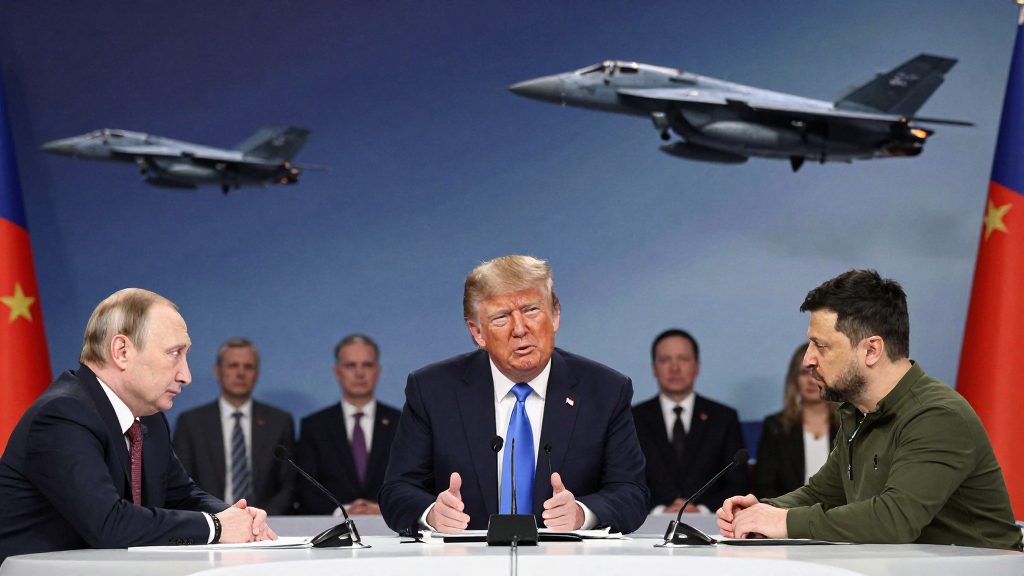
The Dual-Track Gambit
U.S. President Donald Trump held separate calls with Russian President Vladimir Putin and Ukrainian President Volodymyr Zelenskyy over the weekend, administration officials confirmed Monday, launching what the White House described as a parallel diplomatic initiative at the precise moment Russia launched its second large-scale attack on Kyiv in less than a week. The simultaneous use of military pressure and diplomatic outreach underscored the contradictions inside the Trump administration’s approach to ending a conflict now in its fifth year.
The Kremlin said Trump spoke with Putin for 90 minutes, during which the U.S. president offered to help broker a settlement. Ukrainian drones, meanwhile, struck an oil terminal and port area near St. Petersburg — the deepest strike inside Russian territory since the war began, according to Ukrainian military officials.
“There is a real prospect to put an end to this war, and America’s resolve is decisive,” Zelenskyy said in a social media post on Saturday. Officials in Kyiv said the strikes on Russian infrastructure were designed to demonstrate that Ukraine retains the capacity to impose costs even as diplomatic channels open.
NATO Summit Opens Against a Backdrop of Escalation
Heads of state from all 32 NATO member countries are expected in Ankara, Turkey, beginning Tuesday for a two-day emergency summit convened to address the deteriorating security situation on the alliance’s eastern flank. The gathering was called on short notice after Russian missiles struck a civilian apartment block in Kyiv last Tuesday, killing 14 people and drawing widespread condemnation from Western capitals.
NATO Secretary-General Mark Rutte said the summit would focus on accelerating weapons deliveries to Ukraine, tightening sanctions on Russian energy exports, and deploying additional air defense systems to Poland and the Baltic states. “This is not a moment for equivocation,” Rutte told reporters in Brussels on Monday. “The alliance must signal, unmistakably, that it will not allow Russia to redraw borders by force.”
European Union foreign ministers separately convened an emergency session in Brussels and agreed in principle to unlock a frozen 15 billion euro tranche of Russian sovereign assets held in EU custody — a move long resisted by Hungary but now backed by the bloc following the escalation in Kyiv. The funds are expected to be disbursed within weeks, EU officials said.
Markets React to the Ceasefire Collapse
Global markets responded sharply to the convergence of military and diplomatic developments. Brent crude oil rose 2.3 percent to $84.60 a barrel on Monday, driven by supply concerns tied to the St. Petersburg strike and heightened uncertainty over Black Sea shipping lanes. European equity indices fell broadly, with the Frankfurt DAX down 1.8 percent and the Paris CAC off 1.6 percent at midday.
U.S. stock futures also pointed lower, with S&P 500 futures dropping 0.9 percent as investors recalibrated geopolitical risk premiums. The yield on German 10-year Bund fell to 2.41 percent, reflecting a flight to safety as traders priced in a prolonged period of heightened tension. Natural gas futures on the European market climbed 4.1 percent on concerns that strikes near St. Petersburg could disrupt LNG infrastructure in the Gulf of Finland region.
What Comes Next
The Ankara summit will test whether the alliance can present a unified position in the face of simultaneous military pressure and diplomatic overtures from Washington. Multiple sources told reporters that Trump’s national security advisor is expected to attend a closed-door session on Wednesday where ceasefire frameworks will be debated in detail.
Whether the dual-track approach produces movement toward a negotiated settlement — or simply gives each side time to rearm — is expected to become clear in the days immediately following the summit. Three officials familiar with the discussions said no formal ceasefire proposal had been tabled as of Monday morning, and that the talks remained exploratory.