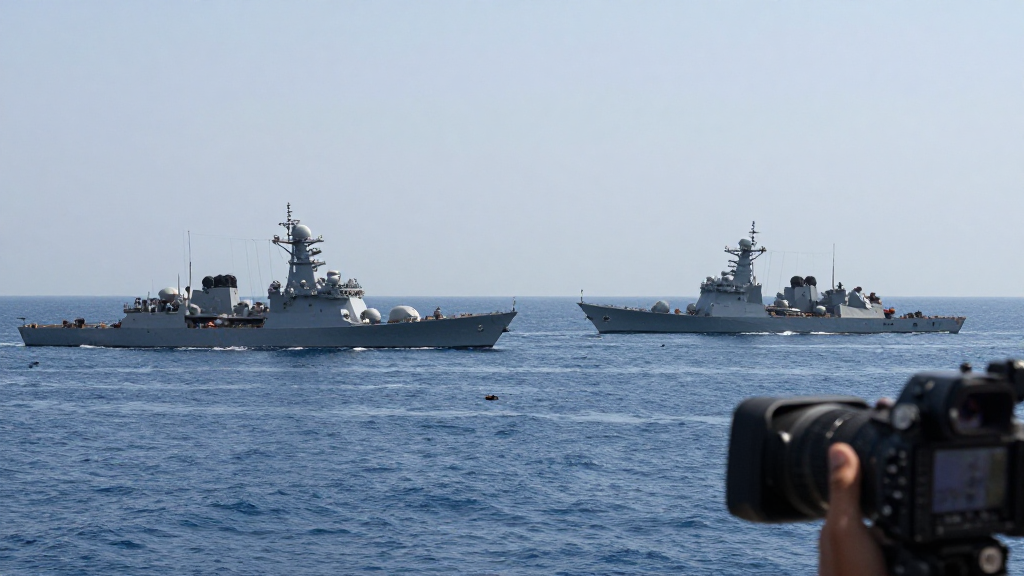
QINGDAO, China — Russian and Chinese warships began a week-long joint naval exercise Monday in the Yellow Sea near this northern Chinese port city, in an operation that defence analysts described as the most consequential iteration of the annual Joint Sea series since its inception in 2012. The drills, running through July 13, bring together surface combatants, submarines and maritime patrol aircraft from both navies in a programme that includes anti-submarine warfare, air defence coordination, live-fire strike sequencing and a post-exercise combined Pacific patrol.
Russian Pacific Fleet vessels led by the Slava-class guided-missile cruiser Varyag docked at Qingdao alongside the frigate Surovy, the Improved Kilo-class submarine Ufa and the rescue vessel Igor Belousov. The People’s Liberation Army Navy contributed the Type 052D guided-missile destroyers Kaifeng and Anshan, the Type 054A frigate Wuhu, the Type 903 replenishment ship Kekexili Lake, one unnamed submarine, naval helicopters and embarked marines. The force composition reflects a deliberate emphasis on integrated maritime task-group operations combining anti-surface, anti-submarine, air-defence and sustained logistics functions inside a contested maritime environment.
Strategic Geometry in the Western Pacific
The exercise unfolds against an intensifying Indo-Pacific security landscape in which Taiwan, the South China Sea and the broader first-island-chain corridor have become central arenas of great-power competition. After the drills conclude, the two navies will conduct a joint maritime patrol in unspecified areas of the Pacific Ocean — a component that analysts say shifts bilateral cooperation from a fixed coastal exercise into sustained blue-water operations traditionally dominated by the United States Navy.
The operational geography near the Yellow Sea and East China Sea inevitably intersects with strategic calculations involving Japan, U.S. carrier deployments and the expanding U.S.-allied deterrence architecture across the region. Japanese maritime authorities have monitored Russian ship movements carefully, reflecting broader concern that recurring bilateral patrols could gradually normalise a more assertive Chinese-Russian naval presence beyond China’s near seas.
Analysts Warn of Coordinated Challenge to U.S. Alliances
Military analysts describe the exercise as an “implicit challenge to a free and open Indo-Pacific,” in the assessment of Mark Davidson, an assistant professor of Asian studies and political science at Temple University Japan. “The strategic quagmire of the American-Israeli war against Iran combined with the Trump administration’s vacillations on aid to Ukraine and force drawdown in Europe have compromised America’s diplomatic and military credibility,” Davidson said by email. Japan, South Korea and Taiwan “have reason to question America’s capabilities and resolve,” he added.
The drills are likely also intended to introduce what Junjiro Shida, a senior associate professor of international studies at Meio University, described as a “cognitive warfare” dimension aimed at unsettling Japanese public opinion. As Japan revises its national security documents focusing on a potential Taiwan contingency, Shida said policymakers must weigh the impact of traditional security threats from North Korea and Russia alongside China’s expanding regional ambitions.
Operational Integration Deepens
Chinese and Russian naval planners are transforming what began as symbolic bilateral exercises into a progressively institutionalised operational framework, analysts said. Joint anti-submarine warfare drills carry particular strategic weight because submarine detection and tracking represent decisive challenges shaping survivability for aircraft carriers, ballistic-missile submarines and surface task groups operating within contested maritime corridors.
The presence of the Type 903 replenishment ship Kekexili Lake highlights how logistical endurance increasingly determines sustained naval pressure during modern high-intensity competition. Russian participation provides China with exposure to long-standing Pacific Fleet operational experience in long-range maritime patrols and blue-water deployments extending far beyond China’s immediate coastal approaches. China simultaneously offers Russia access to expanding logistical infrastructure and advanced port facilities central to Beijing’s ambition of sustaining a permanent naval footprint throughout the Indo-Pacific theatre.
“China has been clear about its intentions in the Asia-Pacific — to dominate and control the region and drive the Americans out,” said Grant Newsham, a retired Marine colonel and senior researcher with the Japan Forum for Strategic Studies in Tokyo. “Taking Taiwan is part of this strategy and Joint Sea 2026 is just one piece of the puzzle as China tightens the noose and expands its regional influence,” he said.
What Comes Next
Although operational integration between both navies remains below formal alliance standards, recurring exercises are steadily reducing friction points that historically limited coordinated maritime manoeuvres. The cumulative effect of repeated bilateral drills since 2012 lies less in immediate combat capability and more in the creation of institutional familiarity that would support faster operational coordination during a future regional emergency or strategic crisis.
The post-exercise Pacific patrol will be closely watched by U.S. Indo-Pacific Command and allied navies for what it reveals about the two navies’ ability to conduct sustained coordinated operations far from their home ports. Upcoming sessions of the Shangri-La Dialogue in Singapore and the annual ASEAN Regional Forum are expected to generate further diplomatic responses from the United States, Japan and Australia regarding the long-term implications of deepening Sino-Russian maritime cooperation for regional stability.