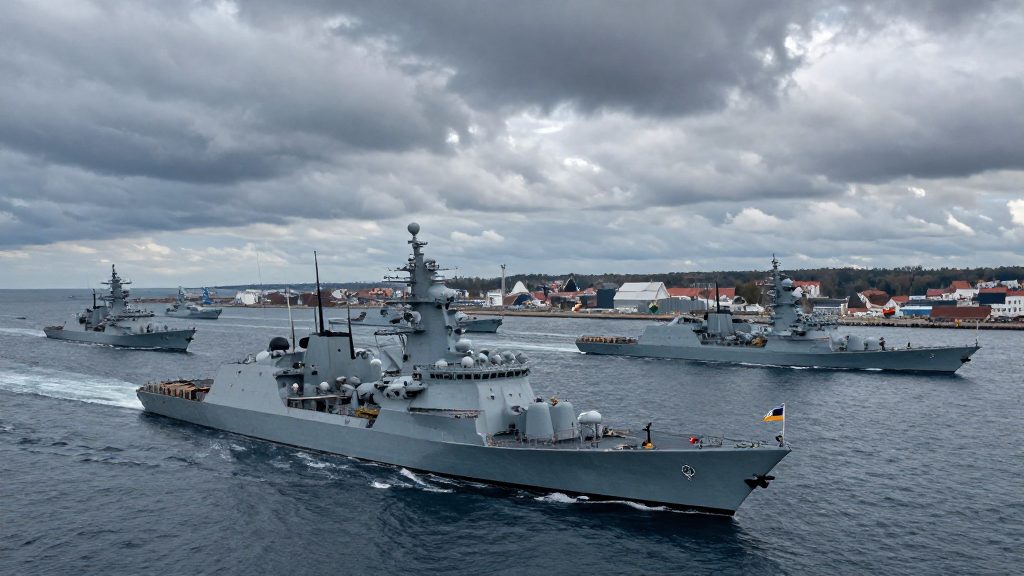
GDYNIA, Poland — NATO launched its largest and most consequential Baltic military exercise of the year on Thursday, deploying naval forces from 15 allied nations across the Baltic Sea in a show of strength that analysts described as a direct signal to Russia amid escalating tensions along the alliance’s northern flank.
Multinational Force Deployed Across Baltic Waters
The exercises, branded BALTOPS 2026, commenced from the Polish port of Gdynia on the Bay of Gdańsk and will run through June 19, concluding in Kiel, Germany. The command ship for this year’s operations is USS Mount Whitney, the flagship of the United States Navy’s Sixth Fleet, operating in close coordination with STRIKFORNATO, the alliance’s rapid-reaction naval command based in Lisbon, Portugal.
More than a dozen NATO member states are taking part, including Belgium, Denmark, Estonia, Finland, France, Germany, Greece, Italy, Latvia, Lithuania, the Netherlands, Poland, Turkey, the United Kingdom, and the United States. Planning for the exercises took place in April in Turku, Finland, hosted by the Finnish Naval Command, with nearly 160 military planners from across the alliance. The involvement of Finland — which joined NATO in 2023 — as the planning host underscored the rapid operational maturation of the alliance’s Nordic-Baltic wing.
“BALTOPS represents the cornerstone of NATO’s collective defence on the north-eastern flank,” said a senior NATO official who briefed reporters in Gdynia. “The Baltic Sea region has moved from the periphery of alliance thinking to its very core since Russia’s full-scale aggression against Ukraine.”
Strategic Importance of the Baltic Sea Corridor
The exercises are centred on the protection of critical sea lanes linking the Baltic states to the rest of NATO territory. The three Baltic nations — Estonia, Latvia, and Lithuania — remain connected to the alliance’s western flank by a narrow land corridor that Russian military planners have long identified as a potential chokepoint. Maritime resupply routes across the Baltic are therefore considered an economic and strategic lifeline for the region’s defence.
Key training areas include surface and sub-surface naval warfare, amphibious assault operations, air defence coordination, mine countermeasures, convoy escort missions, and the neutralisation of unmanned aerial vehicles and incoming missiles. This year’s drills will shift from the western Baltic eastward toward the Swedish island of Gotland, where allied forces will rehearse contested sea-lane protection scenarios.
Poland’s role in the exercises carries particular symbolic weight. For the first time in recent memory, BALTOPS departed from a Polish port rather than the German town of Warnemünde, a decision NATO officials said reflected Poland’s growing stature as a frontline state and the linchpin of the alliance’s eastern deterrence architecture.
“Poland has emerged as the anchor of NATO’s eastern flank,” said General Kazimierz Karkoszka, a former chief of the Polish General Staff. “The decision to launch BALTOPS from Gdynia is not just symbolic — it reflects the operational reality that Poland is where the alliance must hold.”
Russia Watches Closely as NATO Reinforces Northern Flank
Russia’s Defence Ministry acknowledged the exercises in a statement carried by state news agency TASS, calling them a “provocative build-up” near Russian territorial waters and warning that Moscow’s forces would conduct parallel naval drills in response. Russian naval vessels carried out operations in the eastern Baltic during the launch phase of BALTOPS, according to a separate statement from Russia’s Baltic Fleet.
General Karkoszka told Reuters that the timing and scale of BALTOPS 2026 were deliberate. “The message is clear: the alliance will not cede the Baltic,” he said. “Every year this exercise grows in operational sophistication. The interoperability being built here today is the deterrence architecture of tomorrow.”
Estonia, which holds the rotating presidency of the Nordic-Baltic Eight in 2026, made deepening regional defence integration a centrepiece of its priorities this year. In April, NB8 foreign ministers pledged to expand intelligence sharing and joint operational planning, and underscored in a joint communiqué that Russia remained, in their words, “the most serious, immediate, and long-term threat to Euro-Atlantic security across all domains.”
The exercises are unfolding at a moment of particular strain in transatlantic relations. Several European defence officials, speaking on condition of anonymity, acknowledged that the current geopolitical inflection point between Washington and European capitals made the BALTOPS framework more vital than ever as a platform for demonstrating continued alliance cohesion.
“Even as conversations continue at the political level, the military-to-military bonds forged here do not pause,” said one senior European naval officer who asked not to be identified. “Our sailors train together, our ships operate together, and that integration is what the alliance is built on.”
Looking ahead, allied defence planners will monitor Russia’s parallel Baltic drills closely for their scope and duration. The outcome of BALTOPS 2026 will feed into NATO’s ongoing force posture review, which is expected to conclude before the alliance’s autumn defence ministerial in Brussels. That meeting will set the framework for the alliance’s 2027 defence planning cycle, which military officials say will carry significantly increased emphasis on Baltic Sea deterrence.