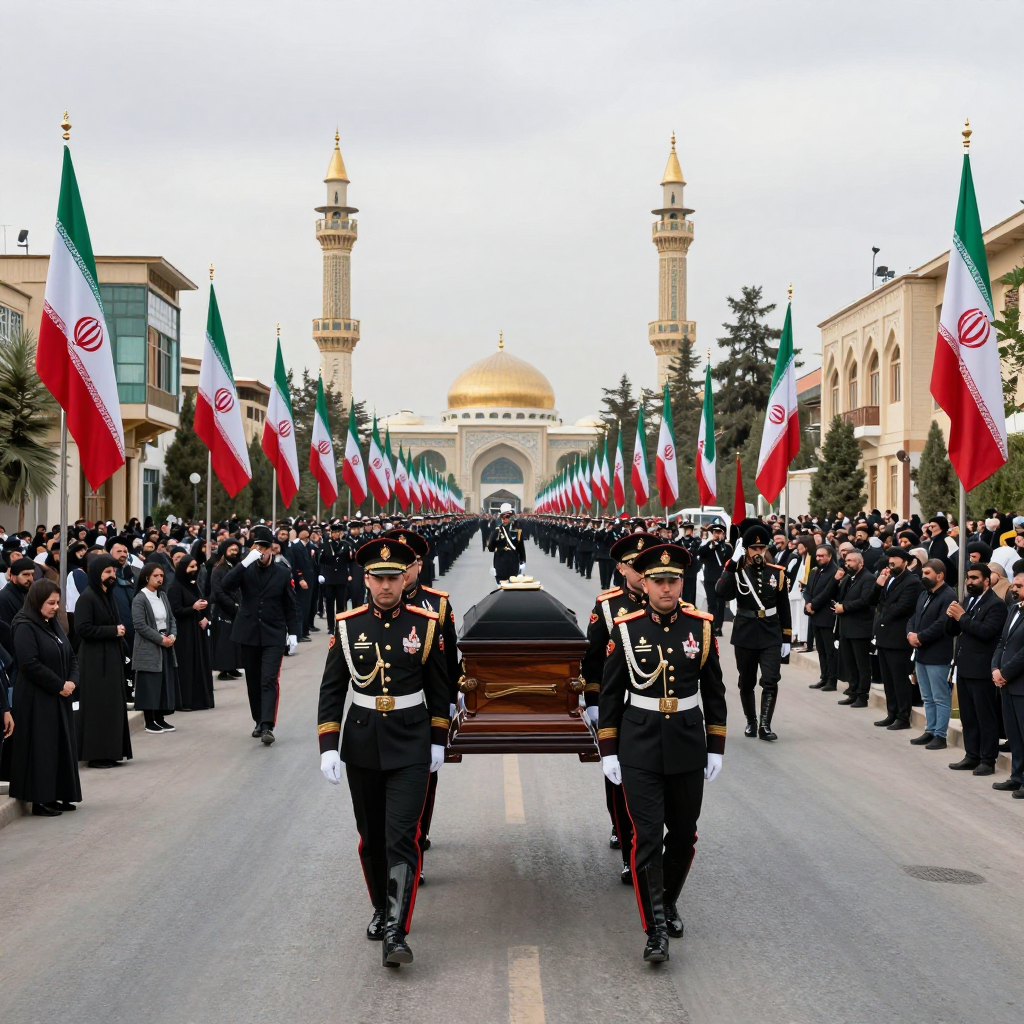
Iran has warned the United States and Israel not to launch strikes during the state funeral of Supreme Leader Ayatollah Ali Khamenei, whose killing in airstrikes triggered the opening round of the current Middle East conflict. Iranian military commanders said any attack during the mourning period would trigger “harsh retaliation,” as American and Qatari mediators convened a new round of talks aimed at preserving a fragile cease-fire.
Tehran Warns Against Funeral Strikes
Commander Ali Abdollahi of the Khatam al-Anbiya Central Headquarters issued the warning Thursday, saying enemies of Iran should avoid any “miscalculation” during the funeral ceremonies. “The enemies of Iran must understand that attacking during this sacred period will be met with a proportional and harsh response,” Abdollahi said in a statement carried by Iranian state media.
Funeral processions for Khamenei begin July 4 in Tehran and will conclude on July 9 with his burial in Mashhad, his hometown. Additional ceremonies are planned in Qom and in Iraq during that period. The timing raises the stakes for both sides: Washington has said it will not be provoked into restarting full-scale combat, but has declined to rule out defensive strikes if Iranian-backed forces attack American personnel or interests.
Waltz Accuses Iran of Violating Cease-Fire Terms at UN
At the United Nations Security Council on July 2, U.S. Ambassador Mike Waltz accused Iran of violating the June 17 memorandum of understanding with Washington by striking Bahrain and Kuwait and disrupting commercial shipping through the Strait of Hormuz. “Iran cannot and we cannot allow it to hold the world’s economy hostage,” Waltz told the council. “President Trump’s patience is not unlimited.”
Bahrain’s Foreign Minister Abdullatif Al-Zayani told the council that Iranian attacks had killed three civilians and wounded 465 others, many of them in strikes on civilian infrastructure and residential areas. Iran’s UN Ambassador Amir-Saeed Iravani rejected the accusations, arguing that countries hosting American military bases had become legitimate military targets because they had facilitated U.S. and Israeli operations. “The presence of American bases in their countries not only does not bring security, but also makes their countries vulnerable,” Iravani said.
Doha Talks Resume Amid Narrow Window for Agreement
American envoys Steve Witkoff and Jared Kushner arrived in Qatar on Tuesday for a second round of indirect negotiations with Iranian representatives through Qatari and Omani mediators. Qatar’s Foreign Ministry said Thursday that the latest session had produced “positive progress” on issues related to the interim agreement, without providing specifics. No direct talks between American and Iranian officials have taken place.
The core dispute centers on what happens to Iran’s nuclear program under a long-term deal. American officials want a permanent freeze on enrichment above civilian levels. Iran insists its enrichment activities are entirely peaceful and are not subject to external dictates. A senior State Department official, speaking on background, said the talks had “narrowed the gaps” but warned that no agreement would be announced before the funeral ceremonies conclude.
What Happens Next
The funeral ceremonies run through July 9, creating a de facto window in which neither side appears eager to resume large-scale hostilities. American military officials have said they are monitoring Iranian force movements closely and remain ready to respond to any provocation. A Pentagon spokesperson told reporters Thursday that U.S. Central Command had increased surveillance flights over the Persian Gulf but stressed that the posture was “defensive and proportionate.”
Diplomats in Doha are expected to continue talks through the weekend, with the next formal session tentatively scheduled for July 10. If no agreement is reached, analysts say the renewed pressure from Waltz at the Security Council signals that Washington is preparing the diplomatic groundwork for more aggressive action. Iran, for its part, has said any American or Israeli strike during the mourning period would be treated as an act of war and would permanently end the negotiating track.