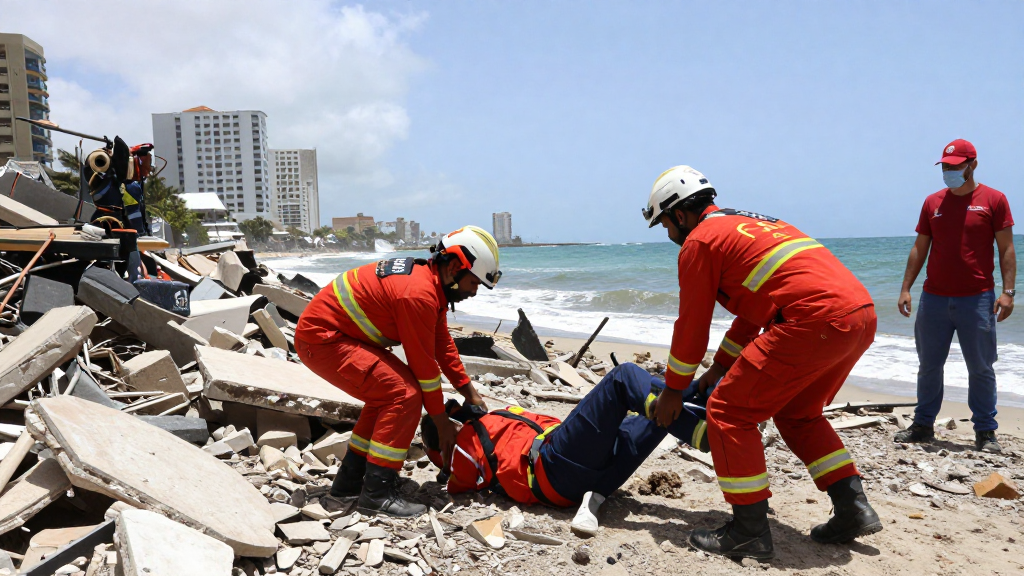
Rescue workers in Venezuela pulled a 43-year-old security guard from the rubble of a collapsed seven-storey building on Thursday, eight days after twin earthquakes devastated the country’s north-central coast. The operation offered a rare moment of hope as the official death toll surpassed 2,200 and international attention shifted decisively from rescue efforts to the mounting humanitarian crisis unfolding across the region.
A Miracle in Catia La Mar
Hernan Gil, a security guard, was located three days earlier beneath the wreckage of the building in the hard-hit coastal area of Catia La Mar. Rescue teams from seven countries worked around the clock, eventually digging a three-metre tunnel to reach him. They supplied him with water via a hose and oxygen through a tube in the days before they could pull him safely to the surface.
“This is truly a miracle,” Gil’s wife Gusbimar Gonzalez told AFP. Cristian Vera, leader of the Chilean rescue team, described the difficulty. “It wasn’t easy to reach the exact spot where the victim was located,” he said, noting that teams navigated unstable rubble for days before the breakthrough.
The Scale of the Catastrophe
The twin earthquakes, measuring magnitudes 7.2 and 7.5, struck Venezuela’s north-central region last week. An estimated 60,000 buildings were damaged or destroyed. The government confirmed at least 2,295 killed, 11,000 injured and roughly 50,000 reported missing, figures that could make this the deadliest natural disaster in the Western Hemisphere in more than a century.
From the state of La Guaira, Al Jazeera correspondent Zein Basravi reported that collapse sites are being marked with a large “D” — signifying deceased — as rescue teams acknowledge no survivors are expected. “The footprint of this disaster is so big,” Basravi said. “There are 58,000 buildings destroyed or damaged, so much area to search, and so many days into the aftermath that it is less and less likely that anyone can be found alive.”
Humanitarian Crisis Looms
The World Food Programme has appealed for $50 million to feed 500,000 people over three months. The United Nations Development Programme estimates physical damage at $6.7 billion based on satellite imagery. The United States pledged $300 million in aid, though the Trump administration’s continued backing of Venezuela’s interim President Delcy Rodriguez has drawn criticism from Maduro-aligned officials who say the relief effort is politically motivated.
Health workers warned that the coming weeks risk a full-blown health crisis, as understaffed and under-equipped medical centres, many themselves damaged in the quakes, struggle to treat tens of thousands of injured residents. Venezuela’s health system has been strained for years by shortages of critical equipment, trained staff and reliable electricity, problems that predated the disaster entirely.
Reporting from Caracas, journalist Noris Soto said international aid will be “more than necessary” in the weeks ahead. “Venezuela has been struggling with economic hardships for the past two decades,” she said. “If you add this disaster to the crisis that already existed, they will need help for years to come.”
The rescue of Hernan Gil offered a brief reprieve from grief. But for tens of thousands of displaced families sleeping in the open, the harder work of survival and reconstruction has only just begun.
International rescue crews from at least a dozen countries have been working alongside Venezuelan teams since the quakes struck. Teams from China, Spain, France and Brazil have all contributed specialised equipment and personnel. The Mexican rescue squad, deployed within 48 hours, brought canine units trained in urban collapse scenarios. Portuguese firefighters used thermal imaging drones to scan collapsed structures for signs of life before the operation shifted toward recovery.
The $300 million US pledge came with conditions, according to sources familiar with the discussions. The funds are tied to access for US personnel in affected zones, a provision that has drawn objections from Caracas. Maduro’s government has publicly rejected what it called “imperial interference disguised as aid.”
Despite the friction, basic necessities are flowing through UN agencies and the Red Cross. Shelter, clean water and cholera prevention are now the most urgent priorities. The Pan American Health Organization warned that standing water from rescue operations, combined with overcrowded shelters, creates ideal conditions for waterborne disease outbreaks including cholera and typhoid.