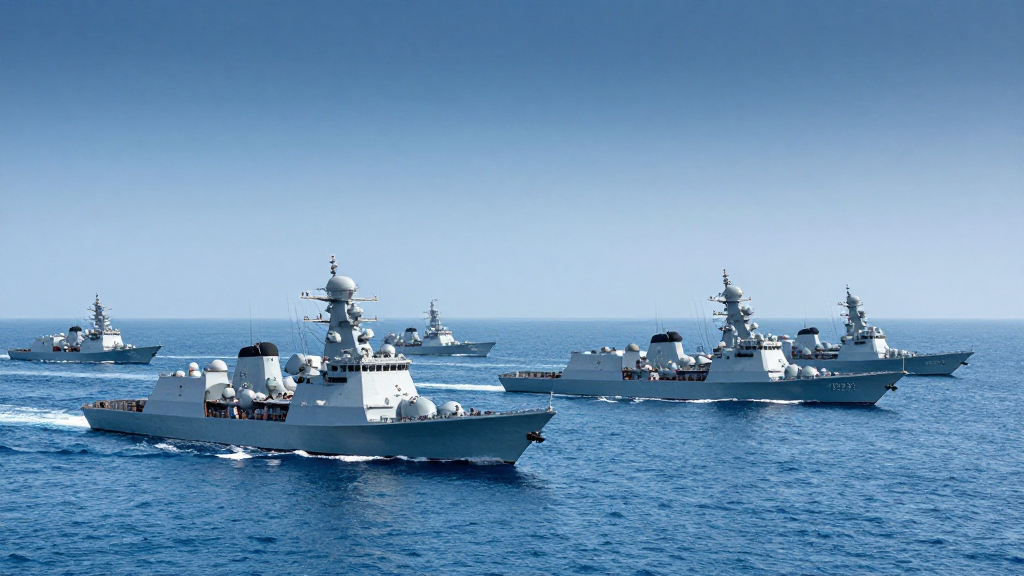
China Naval Response: PLA Drills Mirror Balikatan 2026
Beijing held naval exercises in waters east of Luzon as the United States and the Philippines launched Balikatan 2026, a 19-day joint military exercise that has drawn an unprecedented level of Japanese participation. The People Liberation Army Southern Theatre Command said its drills were “a necessary action taken in response to the current regional situation,” without specifying a timeframe or exact location. Satellite imagery circulating online showed at least 14 large naval vessels on maneuvers, with the Type 055 guided-missile destroyer Zunyi leading a four-ship formation through the Bashi Channel. The drills came as US Secretary of Defense Lloyd Austin visited Manila, meeting with his Philippine counterpart to affirm the mutual defense treaty remains ironclad.
Japan Fires Its First Overseas Missile in 80 Years
The most striking moment of this year Balikatan came when Japan Ground Self-Defense Forces test-fired a Type 88 surface-to-ship missile from Philippine soil, marking the first time Tokyo has launched an offensive weapon from foreign territory since World War II. The projectile struck a decommissioned Philippine warship 75 kilometers off the coast of Ilocos Norte in under six minutes. A US Army Typhon mid-range capability system also fired a Tomahawk cruise missile at a target 630 kilometers away, the first operational use of that system since its controversial deployment to the northern Philippines more than two years ago. China foreign ministry condemned the Japanese firing within hours, calling it “a dangerous escalation and evidence of Japan accelerating neo-militarism under the guise of self-defense.”
Analysts See a Clear Deterrence Signal
Regional security analysts said the joint display was deliberately calibrated to send a layered message across the first island chain. “The message of the exercise is clear,” said Chris Gardiner, chief executive of the Institute for Regional Security in Canberra. “Not today — now is not the time to use force against the Philippines or to change the status quo around Taiwan.” Japan and the Philippines formalized their reciprocal access agreement last month, allowing Japanese ground forces to deploy on Philippine soil for the first time and enabling forward-positioned munitions that would have been unthinkable a decade ago.
Strategic Calculations on All Sides
China simultaneous show of naval force is consistent with its pattern of matching or shadowing US-led exercises in the region. The PLA Navy presence east of Luzon places its fleet within striking distance of any future Taiwan contingency operations while signaling that Beijing will not cede the initiative. The Southern Theatre Command has increased its tempo of live-fire drills by 40 percent over the past year, according to tracking data from the Asia Maritime Transparency Initiative. For the Philippines, the Balikatan exercises represent the most consequential security partnership it has built since the 1951 mutual defense treaty with Washington. President Ferdinand Marcos Jr. welcomed the participating forces at a ceremony in Camp Aguinaldo, saying the exercises demonstrated “the strength of alliances built on mutual respect and shared values.”
Wider Regional Ripples
The exercises come at a delicate moment for Southeast Asian diplomacy. ASEAN foreign ministers are scheduled to meet next week in Vientiane, where the South China Sea code of conduct negotiations will feature prominently. Vietnam and Malaysia have both expressed private concern that the militarization of Balikatan could complicate those talks. Australia, which sent 150 personnel as observers, has signaled interest in formal participation next year. The Quad grouping — the United States, Japan, India, and Australia — has increasingly synchronized its maritime posture around shared domain awareness. For Tokyo, the missile launch represents a visible milestone in its steady dismantling of postwar constitutional constraints on collective self-defense, a trajectory that Prime Minister Fumio Kishida has accelerated under the banner of proactive contribution to peace.
Whether this display of allied strength deters conflict or accelerates the very arms competition that China says it is seeking to avoid remains the central question for the region.