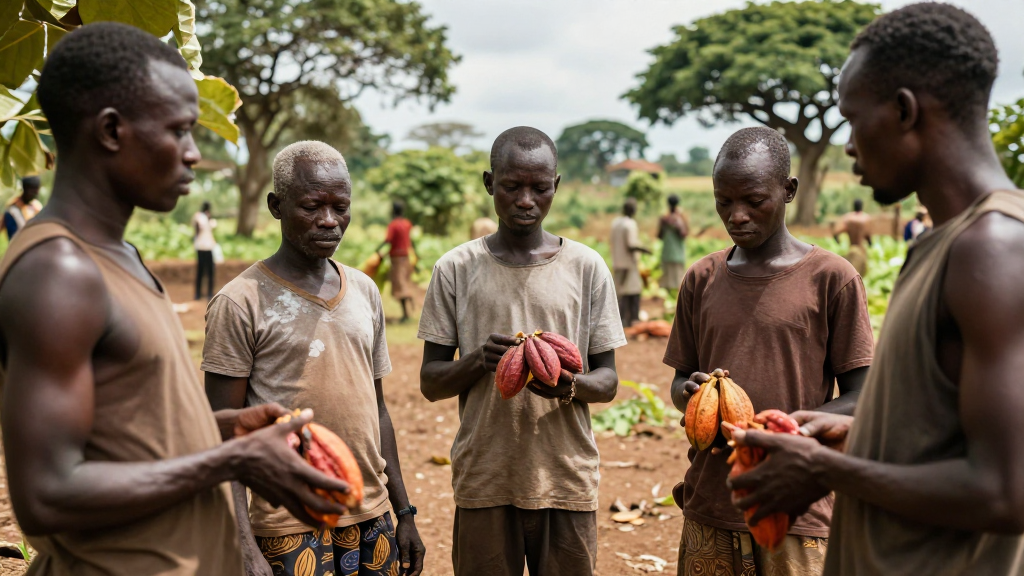
West Africa Bears the Brunt of the Price Crisis
Global cocoa futures have plummeted more than 60 percent from their 2024 peaks, leaving farmers in Côte d’Ivoire, Ghana, and Nigeria unable to cover the cost of harvest. The cocoa sector supports more than 10 million direct livelihoods across the region and generates critical foreign exchange for governments already grappling with debt servicing and currency instability. In some areas, farmers are abandoning entire crops in the fields, a sign of how deeply the crisis has cut into household economies built around chocolate and cocoa beans over generations. Cooperatives that once paid school fees and medical bills are now failing to meet basic operating costs.
“Farmers planted and cared for their trees for years, expecting decent returns. Now they face a market that has simply discarded their work,” said Ghana’s Minister of Agriculture. His comments came during an emergency session of the Economic Community of West African States, where leaders from six nations called for a coordinated price stabilization mechanism and urgent talks with European commodity buyers.
East Africa Copes With Food Inflation and Border Disruptions
In Kenya and Tanzania, rising food import costs are compounding existing drought pressures, with grain and cooking oil prices climbing sharply for the third consecutive month. The cocoa collapse adds a layer of complexity for East African traders who had been exploring alternative commodity partnerships with West African suppliers now facing their own financial distress. Uganda’s central bank has already flagged a widening current account deficit partly attributed to volatile import bills.
The World Food Programme has warned that hunger hotspots are expanding across the Horn of Africa, with the number of people facing acute food insecurity rising by an estimated 18 percent over the past six months. “Communities that survived last year’s floods are now facing a hunger crisis fueled by global price shocks and disrupted supply chains,” a WFP regional director told reporters in Nairobi. Ethiopia and South Sudan have both requested emergency food assistance from international donors, with distributions expected to begin within weeks.
Central Africa Feels the Ripple Effects Through Commodity Markets
In Cameroon and the Democratic Republic of Congo, agricultural commodity markets are being reshaped by shifting trade routes as West African exporters lose revenue and seek new markets for crops that no longer command premium prices in Europe. Cameroon, which exports both cocoa and coffee, is particularly exposed. Its minister of commerce told reporters in Yaoundé that the government is accelerating diversification programs, though these will take years to bear fruit.
The African Development Bank has called for emergency financing to prevent widespread food insecurity from deepening across the region. Regional economists warn that the cocoa price collapse could trigger sovereign debt downgrades if major export-dependent economies fail to adjust their fiscal projections. The Republic of Congo and Gabon are also monitoring the situation closely, with both countries maintaining significant exposure to global soft commodity markets.
Southern Africa Braces as Export Revenues Contract
In South Africa, Mozambique, and Zambia, governments are watching commodity revenue projections carefully as the cocoa crisis joins existing pressures from uneven harvests and persistent power shortages. South Africa’s rand has weakened against the dollar in recent weeks, partly reflecting investor nervousness about emerging market commodity exposure. Mining and agriculture, two pillars of the Southern African Development Community’s export base, face a compounding squeeze.
The African Union has convened an emergency session to discuss coordinated continental responses, with trade ministers from twelve nations expected to present a joint framework for food security resilience by the end of the month. South Africa’s trade minister said his government is exploring bilateral talks with Ghana and Côte d’Ivoire to support farmer-level interventions while longer-term market reforms take shape.
North Africa Monitors Spillover Through Mediterranean Trade
In Morocco, Tunisia, and Egypt, the cocoa price collapse is registering as a secondary but measurable shock through commodity processing and food manufacturing sectors. Morocco’s confectionery exports to Europe have declined as European buyers cut orders in response to softening global demand. Egypt, which imports significant quantities of agricultural raw materials, is adjusting its trade balance forecasts downward for the second quarter.
The impact in North Africa is less direct than in sub-Saharan regions but analysts say it underscores how deeply integrated African economies have become with global commodity cycles that often operate outside the control of the farmers and workers who bear the greatest burden when prices fall. “The structural vulnerability is the same across the continent, only the timing of the shock differs,” said an economist at a Cairo-based research institute.
The collapse of cocoa prices represents more than a regional agricultural shock. It exposes deep vulnerabilities in how African economies are integrated into global commodity markets, and it raises urgent questions about who bears the cost when those markets turn against smallholder farmers who had no say in how they were structured. For the millions of families across five African regions navigating this crisis simultaneously, the answers cannot come fast enough.