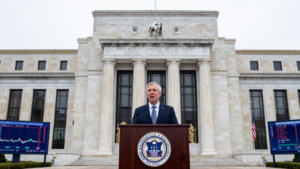
Fed Holds Rates as Warsh Signals Inflation Risks Are Easing
Federal Reserve Chairman Kevin Warsh told attendees at the European Central Bank Forum on Central Banking in Sintra, Portugal, on Wednesday that inflation risks have come down in recent weeks, offering a cautiously optimistic assessment as the central bank navigates a complex economic landscape. Speaking at the closely watched event, Warsh noted that energy prices have retreated substantially since the United States and Iran signed a memorandum of understanding to end the ongoing conflict last month, a development that has helped cool one of the most persistent drivers of consumer price growth. The Fed chief stopped short of signaling imminent rate cuts, however, underscoring that policymakers remain focused on confirming the disinflationary trend before shifting course. The Fed held its benchmark interest rate steady in a range of 3.50% to 3.75% at its most recent meeting, maintaining what officials have described as a restrictive stance intended to keep pressure on inflation. Market participants parsed Warsh’s remarks carefully for clues about the trajectory of monetary policy, with traders noting that his acknowledgment of declining inflation risks marked a subtle but notable shift in tone from his predecessor’s more hawkish communications.
Energy prices have come down substantially, Warsh said, noting that the diplomatic breakthrough between Washington and Tehran has taken one of the most volatile inputs out of the inflation equation. They’re still a bit above where they were pre-conflict, but they’ve come down. The Consumer Price Index jumped to 4.2% in May, its highest reading since 2023, driven primarily by energy and services inflation, before showing signs of moderation in early June data. The Fed’s preferred inflation gauge, the Personal Consumption Expenditures price index, similarly showed elevated price growth, prompting policymakers to adopt a wait-and-see posture rather than rush toward accommodation.
AI Investment and the Long-Term Outlook
Beyond near-term inflation dynamics, Warsh offered an extended assessment of how artificial intelligence is reshaping the economic landscape, sounding a relatively optimistic note on the technology’s long-term productive potential. We are being hit by a series of shocks in the U.S., Warsh told the forum audience, referencing geopolitical instability, pandemic-era supply chain disruptions, and the AI revolution simultaneously reshaping industries from healthcare to finance. The AI shock is leading to a boom in capital expenditures. We see that first and foremost in demand, but I am confident we are going to see it in supply at some point, he added. The surge in AI-related investment has complicated the inflation picture in ways that remain difficult to quantify. Demand for advanced semiconductors, data center construction, and specialized computing infrastructure has injected fresh vigor into certain sectors even as monetary policy works to cool aggregate demand.
The Fed’s Independence and the Political Calculus
Warsh also addressed questions about the Federal Reserve’s institutional independence, a topic that has drawn renewed attention amid ongoing debate about the relationship between monetary policy and fiscal priorities. We have been an independent central bank for a very long time. We are going to be an independent central bank at this moment, and you are going to see no changes on that, Warsh said, in apparent response to speculation about political pressure on rate decisions. The Fed chair declined to offer any concrete guidance on the timing or pace of future rate adjustments, breaking with the practice of his predecessor under the so-called dot plot framework that attempted to signal likely rate paths years in advance. Instead, Warsh emphasized that the central bank would remain responsive to incoming data, particularly on inflation and labor market conditions, rather than lock in a predetermined course. The approach reflects a broader recalibration of Fed communications strategy, one that prioritizes optionality and flexibility in an environment where economic shocks have arrived with unusual frequency and unpredictability.
Market Reaction and Rate-Cut Expectations
Financial markets registered a cautiously positive reaction to Warsh’s remarks, with equity indices posting modest gains and Treasury yields edging lower as investors interpreted the chairman’s softening tone on inflation risks as a signal that the rate-hiking cycle may be approaching its terminal phase. Futures markets shifted to price in an elevated probability of at least one rate cut before the end of the year, though traders acknowledged that the path remains highly data-dependent and could shift rapidly if incoming inflation reports surprise to the upside. The dollar index weakened marginally against a basket of major currencies, reflecting expectations that a less aggressive Fed stance could narrow interest rate differentials with other central banks. Bond markets, meanwhile, continued to grapple with the so-called mortgage lock-in effect, whereby homeowners reluctant to sell properties locked into low-rate mortgages have constrained housing supply, keeping home prices elevated and complicating the Fed’s effort to cool shelter inflation.
What Comes Next for the Fed
The Federal Reserve’s next scheduled policy meeting is set to convene in late July, when officials will have access to an updated batch of inflation, employment, and consumer spending data. Economists surveyed by major research firms expect the committee to hold rates steady once again while continuing to assess whether the recent moderation in energy-driven price pressures represents the beginning of a durable disinflationary trend or a temporary reprieve. The central bank’s decision will carry significant implications for borrowing costs across the economy, influencing everything from mortgage rates to corporate credit spreads to the fiscal positions of state and local governments. Consumer confidence surveys have shown mounting dissatisfaction with prevailing economic conditions, particularly among lower- and middle-income households that continue to feel the strain of persistent price increases even as the broader trend shows improvement. Warsh has made clear that the Fed will not be rushed into action based on political considerations or short-term market volatility, and that its commitment to price stability remains paramount even as the economic landscape evolves in unexpected ways. The coming months will test whether the combination of declining energy costs, AI-driven investment, and a resilient labor market can produce a so-called soft landing, or whether lingering inflationary pressures will force the Fed to maintain its restrictive stance longer than markets currently anticipate.