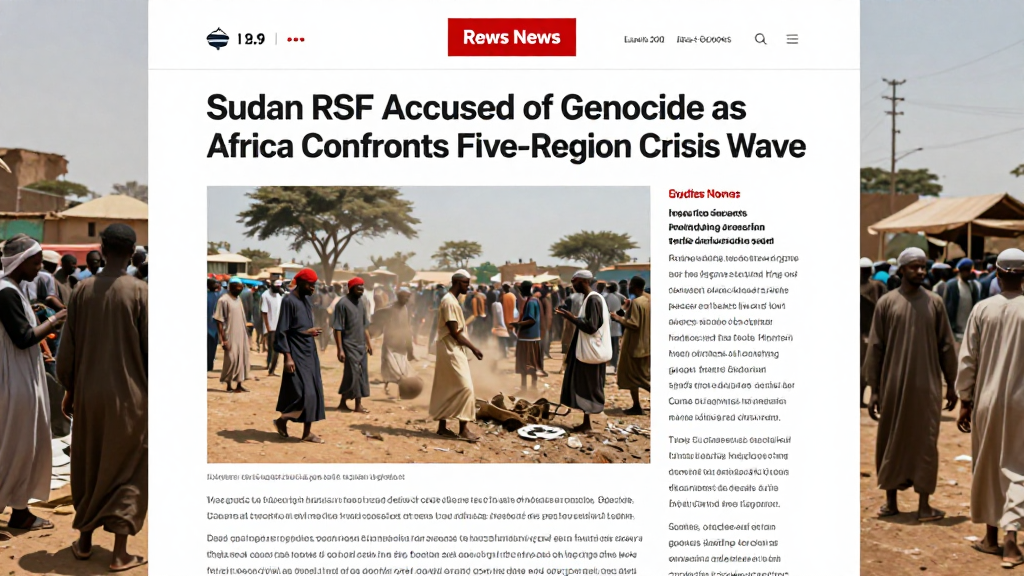
North Africa: Sudan’s RSF Accused of Crimes Against Humanity
Amnesty International’s landmark report, released this week, documents crimes against humanity, ethnic cleansing and possible genocide committed by Sudan’s Rapid Support Forces across North Darfur. Interviewing 247 survivors and witnesses between early 2024 and October 2025, the human rights organization catalogued murders, torture, rape, sexual slavery and the deliberate targeting of civilians belonging to the Zaghawa ethnic group, including children. The RSF has denied previous allegations of war crimes. The civil war, now in its fourth year, has generated the world’s worst humanitarian crisis, with more than 14 million people displaced and 28 million facing acute hunger. The UN Human Rights Council held an emergency session this week amid warnings that 500,000 civilians near el-Obeid face imminent risk of large-scale atrocities.
West Africa: Nigeria Seeks Reparations From South Africa
In a rare diplomatic confrontation between Africa’s two largest economies, Nigeria announced it will seek formal compensation from South Africa for citizens who fled anti-migrant violence, abandoning businesses, homes and other assets. More than 600 Nigerians have already been repatriated, with hundreds more awaiting evacuation as xenophobic attacks continue to target foreign-owned enterprises in Johannesburg, Cape Town and Durban. The Nigerian foreign ministry said some of those affected held legal residency permits, disputing South African assertions that all repatriated citizens were undocumented. The dispute has strained bilateral relations at a time when both governments are under pressure to address the economic grievances fuelling resentment against migrants.
Central Africa: Ebola Outbreak Deepens Across Congo
A deadly Ebola outbreak continues to spread across the Democratic Republic of Congo, overwhelming health infrastructure already strained by years of armed conflict. Aid workers with Medecins Sans Frontieres report that treatment centres in Mbandaka and neighbouring provinces are operating beyond capacity, with health workers themselves falling ill. Contact-tracing efforts are being hampered by insecurity in remote communities, raising the spectre of silent transmission chains going undetected. The World Health Organisation has classified the outbreak as a Public Health Emergency of International Concern, and regional health ministers have called for an emergency coordination summit with funding commitments still unmet.
East Africa: Uganda Media Crackdown Widens
Uganda’s government banned three national newspapers and imposed sweeping social media restrictions following the arrest of opposition leader Kizza Besigye on treason charges. The Committee to Protect Journalists condemned the move as an escalating assault on press freedom. “The government is using national security as a pretext to silence every independent voice,” the CPJ said in a statement, adding that the shutdowns had cut off millions of readers from reliable information. The restrictions follow a broader pattern of press freedom erosion under the current administration, with journalists covering opposition activities facing harassment and arbitrary detention.
Southern Africa: Anti-Migrant Unrest Spreads Beyond South Africa
More than 900 people have been arrested during anti-migrant protests that swept South Africa this week, according to government figures. The demonstrations, centred on major urban centres, targeted foreign-owned businesses and informal settlements where migrants from Zimbabwe, Mozambique and Nigeria have settled. President Cyril Ramaphosa called an emergency cabinet meeting and appealed for calm, acknowledging that economic stagnation and unemployment were driving resentment but insisting that violence would not be tolerated. The unrest has spilled across the border, with Tanzania reporting a surge in anti-foreigner rhetoric and small-scale protests in Dar es Salaam.
Regional Response Under Severe Strain
Across all five African regions, humanitarian organisations are sounding the alarm over converging crises that are overwhelming response capacity. The UN Office for the Coordination of Humanitarian Affairs reported that funding for Africa operations is at its lowest level since 2020, while the number of people in acute need has risen by 18 percent in the past year. Aid workers in Sudan, DRC, Uganda and South Africa describe a grim arithmetic: more people requiring assistance, fewer resources to reach them, and conflict dynamics making access more dangerous by the week. The African Union faces mounting pressure to convene an emergency heads-of-state summit to coordinate a unified continental response.