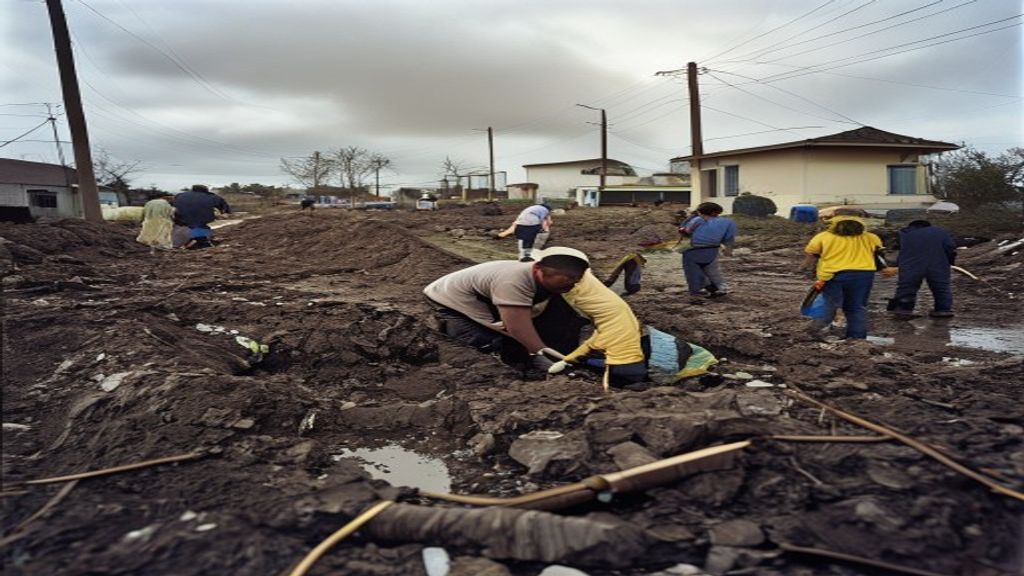
LA GUAIRA, Venezuela — Nearly a week after two massive earthquakes struck the Venezuelan coast, killing nearly 2,000 people, residents of La Guaira are pulling friends and family from the rubble with their bare hands while government heavy machinery sits idle for lack of fuel — a stark symbol of a country sitting atop the world’s largest oil reserves yet unable to keep its own rescue equipment running.
At one collapsed building in the port city, a government excavator stood motionless beside a pile of concrete and twisted rebar. When CNN asked the operator why it was not working, he said there was no gasoline. Within sight of the Atlantic coast, neighbors formed human chains to sift through debris by hand, passing rubble bucket to bucket in the sweltering heat while aid that had arrived by plane sat undelivered at the airport.
Government Response Under Scrutiny
The contrast between official inaction and community desperation has ignited fury across the country. Political analyst Carmen Beatriz Fernanda, director of the consulting firm DataStrategia, told CNN: “People are outraged. What we are seeing is this tragedy as a reflection of another tragedy, which was dedicating the state’s capabilities solely to repression and propaganda. You dismantled a state’s capacity to provide basic needs.” Her words resonated widely on Venezuelan social media, where videos of residents digging with shovels and their hands have been viewed millions of times.
The government of acting President Delcy Rodriguez, who assumed power after Nicolas Maduro was removed from office in January, has pledged full mobilization. But on the ground in La Guaira, rescue crews say the official response has been slow and disorganized. Four officials were arrested Tuesday after the criminal investigation body CICPC said they had been “appropriating valuables found in the rubble” of collapsed buildings. The arrests did little to quiet critics who say the government’s priorities remain misplaced.
International Aid Arrives as Needs Skyrocket
The 7.2 and 7.5 magnitude quakes struck less than a minute apart on June 24, roughly 40 kilometers north of Caracas, sending shockwaves across the northern coastline. More than 6,400 people have been rescued so far, according to Venezuelan authorities, but the United Nations warned Tuesday that the true scale of the disaster is still emerging. “As the death toll rises, needs are skyrocketing,” the UN refugee agency UNHCR said in an online alert.
A 47-tonne shipment of humanitarian supplies from UNICEF arrived in Caracas on Tuesday, the second such delivery in as many days. The cargo, facilitated through the European Union’s logistics hub in Copenhagen, included emergency health kits, water purification supplies, birthing kits, and tents for child-friendly spaces — enough to support more than 100,000 children and families over three months. A previous shipment from Panama arrived on June 28.
Gabriel Vockel, a UNICEF official speaking in La Guaira, described what teams are finding on the ground. “Many are sleeping outside, afraid of more aftershocks,” he said. “The first flights with water, medicine and many other supplies have reached the country and we are grateful for the solidarity. And we ask for donations to UNICEF because with more funds, we can save more lives, reach more children, and reach as many families as possible.”
Infrastructure Decimated Across the North Coast
The physical destruction is enormous. Approximately 1,000 buildings, including hospitals, have been damaged or completely destroyed, along with more than 400 schools and regional water systems. Entire blocks of the historic port district of La Guaira have been reduced to rubble, and crews from Mexico, Brazil, Chile, Spain and the United States are working alongside Venezuelan volunteers in a coordinated search that officials say could take weeks to complete.
Roberto Benes, UNICEF’s regional director for Latin America and the Caribbean, said families across the affected states are in urgent need of safe water and medical care. “Many are sleeping outside, afraid of more aftershocks,” he said. “These supplies will help us reach children and families with what they need most right now. But the needs are enormous and growing.” The UN disaster assessment coordination team, UNDAC, is continuing its work to map where and for whom humanitarian assistance is most urgently needed, officials said Wednesday.
For now, the manual rescue work continues block by block in La Guaira, where neighbors who cannot count on the state are counting on each other instead.