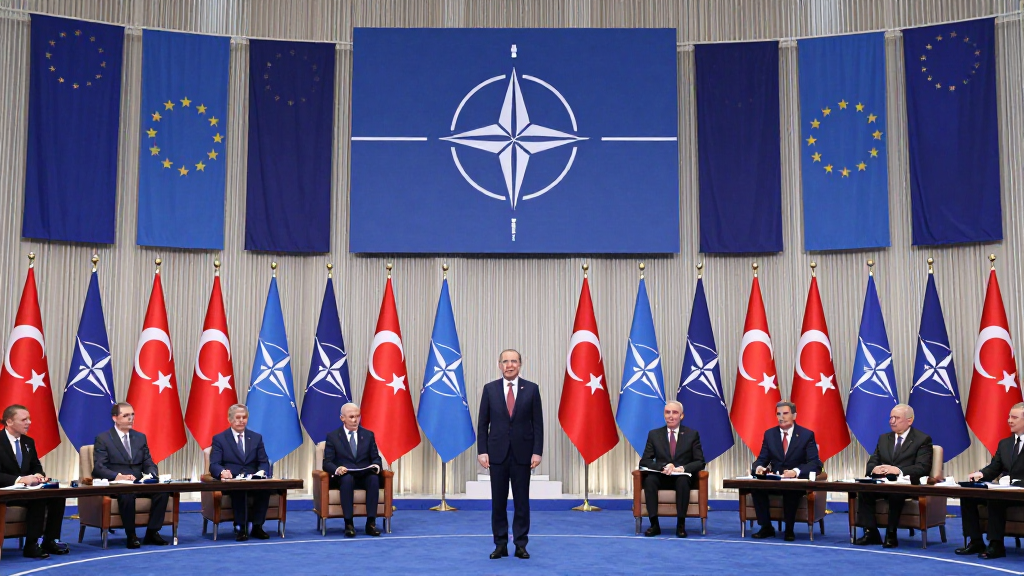
ANKARA, Turkey — NATO leaders gathered in this Turkish capital on Tuesday for a two-day summit that allies described as the most consequential gathering of the alliance in years, convening against a backdrop of the grinding war in Ukraine, heightened Russian pressure along the eastern flank, and an unresolved debate over the future scale of the United States military presence in Europe.
Forty Thousand Personnel and a Fortress City
Turkish authorities sealed off central Ankara as the summit formally opened at the Besiktepe Presidential Compound. According to the Turkish Defence Ministry, approximately 40,000 security personnel were deployed across the capital, supplemented by missile-defence installations, F-16 fighter patrols and anti-drone systems. Interior Minister Ali Yerlikaya told reporters at a briefing centre near the compound that the operation represented the largest single-city security mobilisation Turkey had undertaken in a decade.
Secretary General Mark Rutte arrived with a packed agenda. His office circulated a concept note listing five priority areas: accelerating defence production and ammunition stockpiling, expanding NATO’s integrated air and missile defence architecture, deepening partnerships with Indo-Pacific allies, strengthening support for Ukraine, and adopting a new regional posture for the Black Sea and Baltic Sea flanks. A senior NATO official told journalists on condition of anonymity that the final communique was expected to include, for the first time, a specific numerical target for pre-positioned allied equipment along the Polish and Romanian borders.
The Five Percent Question and American Leadership
The summit’s most politically charged issue remained defence spending. Under a commitment revived during the previous administration, NATO members had pledged to allocate a minimum of 5 percent of gross domestic product to defence and security. The United States Ambassador to NATO, Matt Whitaker, framed the stakes in blunt terms ahead of Tuesday’s sessions.
“The NATO Summit starts on July 7 in Ankara,” Whitaker said in a pre-summit statement released by the alliance’s press service. “Next month’s pivotal meeting will serve as a progress report on the 5 percent defence commitment. Under President Trump’s leadership, Allies are moving beyond pledges and returning NATO to its war-fighting roots.” The remarks signalled that Washington would be watching closely which members had met the benchmark and which had not.
European defence analysts said the 5 percent target, while symbolically powerful, still lacked agreement on what expenditures counted toward it. NATO’s own definition of defence investment includes military personnel costs, equipment procurement and infrastructure, but excludes humanitarian and development spending that several European governments have argued should qualify.
Turkey’s Strategic Weight and the Black Sea Dimension
Turkey’s role as host carried unusual geopolitical significance. Ankara possesses the second-largest conventional army within the alliance, a domestic defence industry that exports armed drones and armoured vehicles to more than thirty countries, and a strategic geography placing it at the intersection of the Black Sea, the Caucasus, Syria and the eastern Mediterranean. President Recep Tayyip Erdogan used his opening remarks to push NATO members toward what he called a more comprehensive conception of security.
The Black Sea flank drew particular attention. Turkey controls the Montreux Convention passage regime governing naval access to the Black Sea, a legal architecture that has constrained Russian and Ukrainian naval operations throughout the conflict in Ukraine. NATO’s new strategic concept designates the Black Sea as a region of strategic interest, yet allied naval presence there remains limited. Alliance defence ministers discussed a proposal to establish a permanent allied naval task group in the Black Sea on a rotational basis, though any such arrangement would require delicate negotiation with Turkey given the Montreux constraints. “Turkey is indispensable to everything we do in this region,” Rutte told reporters at the closing press conference. “We do not have a credible plan for the Black Sea that does not include Ankara.”
Ukraine, the Indo-Pacific and What Comes Next
Ukraine’s future within the alliance architecture occupied the final hours of Tuesday’s plenary sessions. The alliance’s support package for Kyiv was formally extended through 2027. Rutte told a joint press conference that NATO allies had collectively committed more than 126 billion euros in security assistance to Ukraine since the full-scale Russian invasion began, a figure that Western officials said represented the largest sustained aid programme the alliance had undertaken outside its own membership.
Separately, NATO’s outreach to Indo-Pacific partners featured on the formal agenda for the first time in summit history. Australia, Japan and New Zealand sent senior delegation officials who participated in a working session on shared threats. A joint declaration from the four Indo-Pacific partners was expected before the summit concluded.
The alliance faces a period of consequential decisions in the months ahead. NATO’s military command is scheduled to present its new regional plans to defence ministers at a follow-on meeting in October. Those plans, which specify which national forces would deploy where and under what circumstances, are considered the operational backbone of the alliance’s deterrence posture. Alliance officials said the Ankara summit had given political direction to accelerate their finalisation.
Leaders also agreed to reconvene in informal format in Brussels in September for a focused discussion on defence industrial base coordination. European defence industry analysts have warned that unless allied governments accelerate contracts for artillery ammunition, air defence interceptors and armoured vehicles, the alliance’s own readiness stocks could face constraints within eighteen months. The next regular summit is scheduled for Warsaw in 2027, where members expect to finalise the next round of force commitments under the alliance’s new regional plans.