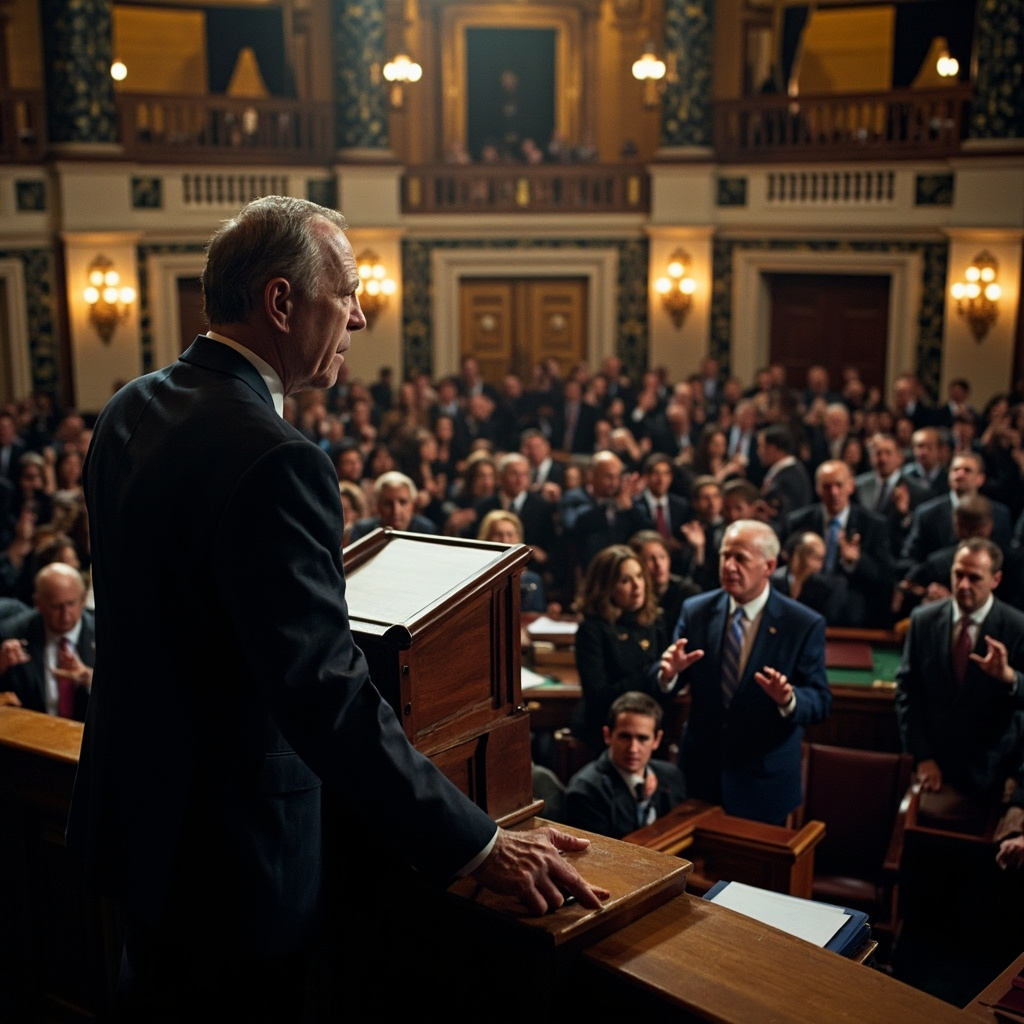
House Speaker Mike Johnson faced a second consecutive week of Republican mutiny on Thursday, as a bloc of 14 conservative lawmakers joined Democrats to defeat a procedural rule advancing the National Defense Authorization Act, deepening the crisis over the party’s legislative agenda just days before a scheduled recess.
The 198-224 Vote and the Republican Defectors
The 198-224 vote to block the rule killed a procedural maneuver that would have paired the NDAA with the Safeguard American Voter Eligibility, or SAVE America, Act — a top Trump priority requiring proof of citizenship to register to vote and present government-issued identification to cast a ballot. The defeat left Johnson without the votes needed to move the annual defense policy bill, the annual Pentagon spending roadmap that has passed Congress for 63 consecutive years.
The 14 Republicans who voted against the rule were Reps. Tim Burchett of Tennessee, Eric Burlison of Missouri, Eli Crane of Arizona, Randy Fine of Florida, Andy Harris of Maryland, Anna Paulina Luna of Florida, Max Miller of Ohio, Chip Roy of Texas, Keith Self of Texas, Victoria Spartz of Indiana, Mike Turner of Ohio, Thomas Massie of Kentucky and Lauren Boebert of Colorado. House Majority Leader Steve Scalise of Louisiana also cast a procedural “no” — a maneuver allowing leadership to bring the bill back for another vote.
“We need to be on offense, and we’re not,” Roy said on the House floor. “We ought to be codifying what the president’s doing.”
The SAVE Act Showdown and Senate Standoff
At the heart of the standoff is the SAVE America Act, which passed the House in February but has languished in the Senate, where it faces a 60-vote procedural hurdle and deep Democratic opposition. Johnson had proposed a workaround: a procedure called MIRVing that would allow both the NDAA and the SAVE Act to be transmitted to the Senate together under a single rule, theoretically protecting vulnerable House Republicans from politically difficult votes while meeting Trump’s demand for action on voting security.
Hardliners led by Luna dismissed the maneuver as insufficient. Luna argued that MIRVing would do nothing to prevent Senate Majority Leader John Thune from stripping the SAVE Act from any combined package or simply refusing to take it up at all.
“I think I probably went public with some information I shouldn’t have,” Luna told Punchbowl News, referring to earlier discussions about Senate procedural tactics including the standing, or talking, filibuster — a maneuver that would force Democrats to hold the Senate floor continuously rather than simply invoking the 60-vote cloture threshold. Senate Republicans, including Thune, have dismissed the talking filibuster tactic as impractical and potentially dangerous to Senate Republican priorities beyond the SAVE Act.
The vote also reflected competing policy agendas beyond immigration. Turner, Miller and Spartz had demanded that the NDAA include provisions restoring pensions for Delphi salaried retirees following a failed government bailout — a flashpoint that drew bipartisan attention but ultimately was not included in the rule package.
A Frail Majority and a Recess Deadline
Thursday’s defeat was the second straight week that conservative opposition paralyzed the House floor, delaying the NDAA and derailing the broader legislative agenda ahead of the Independence Day recess. The failed vote underscored the limits of Johnson’s narrow majority: with just a handful of defections, the speaker cannot afford to lose more than two or three Republicans on any given vote.
The White House issued a statement calling on Congress to pass both the NDAA and the SAVE Act before the recess, framing the defense bill as essential to national security and the voting measure as essential to election integrity. Trump reiterated his support for the SAVE Act in a Truth Social post, calling it “critical to making our elections honest and secure.”
Senate Majority Leader John Thune told reporters that the Senate would take up the NDAA “when the House sends it to us” but offered no timeline for action on the SAVE Act, which faces certain procedural obstacles in the upper chamber.
The standoff sets up a high-stakes week of negotiations before the recess. Johnson must find a way to thread the needle between Trump’s legislative demands, the Senate’s procedural constraints and a restless conservative caucus that has shown no willingness to defer to leadership — a test that will define his speakership as the 2026 midterm season approaches.