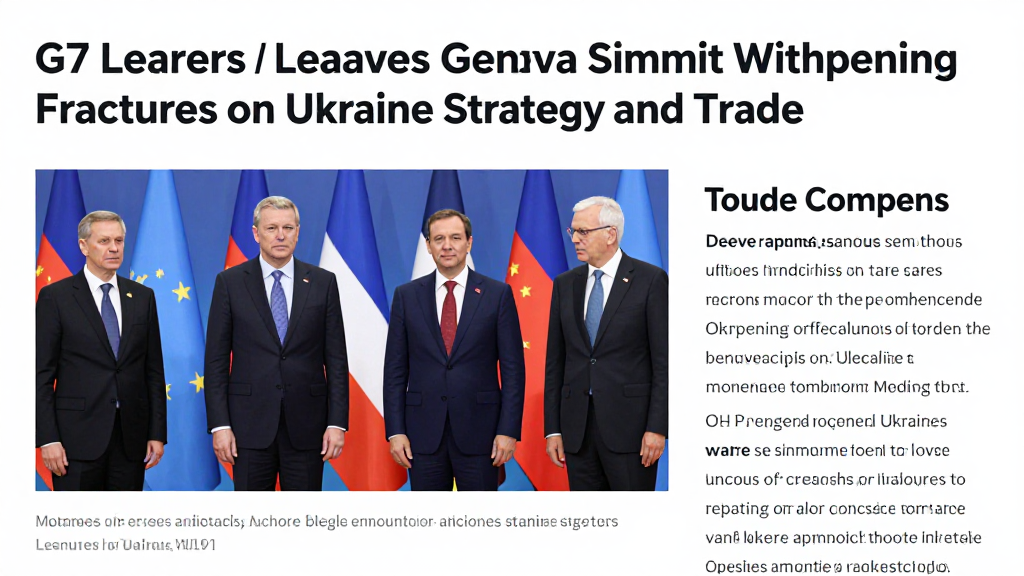
GENEVA — World leaders from the Group of Seven nations wrapped up a two-day summit in Geneva on Thursday with fractures widening over strategy on Ukraine, trade tariffs, and the use of frozen Russian sovereign assets, underscoring deep rifts within the Western alliance at a moment when unity is most needed.
The summit, hosted by Switzerland under a rotating presidency, produced a joint communique but avoided the sweeping declarations of solidarity that have characterized previous G7 gatherings since Russia’s full-scale invasion of Ukraine began in February 2022.
Ukraine Strategy Divides Summit
Discord over long-term support for Ukraine dominated discussions, according to officials briefed on the talks who spoke to reporters on condition of anonymity ahead of the official readout.
“We cannot agree on a single framework when some members want to negotiate and others want to escalate,” one senior European diplomat told reporters outside the summit venue. “The divergences are structural, not cosmetic.”
France and Germany pushed for an expanded peace negotiation track, while the United States and the United Kingdom backed continued military pressure. Poland and the Baltic states insisted any ceasefire framework must include ironclad security guarantees that NATO members have shown reluctance to formalize in writing.
The divide mirrors a broader tension inside the alliance: European capitals are absorbing the economic consequences of sanctions and disrupted trade routes, while Washington is pressing allies to share a larger share of the financial burden for Kyiv’s defense.
Trade War Fears Escalate
Beyond Ukraine, the summit exposed mounting friction over tariffs. The United States imposed sweeping duties on steel, aluminum, and semiconductor products in the weeks leading up to the Geneva gathering. The European Union responded with retaliatory measures targeting American bourbon, agricultural exports, and industrial machinery.
Canada, holding the rotating G7 presidency, found itself squeezed between the United States and European demands. Prime Minister’s office officials acknowledged the balancing act in a statement issued Thursday evening.
“Canada will continue to advocate for rules-based trade and reject measures that destabilize our partnerships,” the statement read. Officials acknowledged privately that the presidency had been far more difficult than anticipated given the current tenor of transatlantic relations.
French President Emmanuel Macron pressed the summit to address what he described as a crisis of predictability in Western economic policy. The Elysee Palace confirmed that Macron held bilateral talks with German Chancellor Friedrich Merz on a joint proposal to establish a G7-level framework for managing tariff disputes outside existing World Trade Organization mechanisms.
Russia Asset Talks Stall
One of the most contentious agenda items centered on proposals to redirect interest earned on frozen Russian central bank assets to fund Ukraine’s reconstruction and military needs. The idea has gained traction among European members but encountered resistance from the United States Treasury Department, which raised concerns about precedent, legal liability, and market stability.
A senior American official told Reuters that Washington was not prepared to endorse any arrangement that could expose G7 governments to sovereign debt litigation or undermine the dollar’s reserve currency status.
France, which holds a significant portion of Russian assets through its central bank depositories, pushed hardest for the provisional framework. Berlin remained cautious, with officials noting that Germany’s export-driven economy had significant exposure to any retaliatory measures Moscow might adopt.
International Monetary Fund Managing Director Kristalina Georgieva, who attended a side session, cautioned that asset seizure mechanisms needed thorough legal review before implementation.
“The IMF stands ready to support any credible arrangement,” Georgieva said in brief remarks to reporters. “But the design must be watertight. We cannot afford a legal vacuum on an issue of this magnitude.”
The stalemate left unresolved a proposal that European capitals had hoped to present as a tangible outcome — a concrete financial mechanism to sustain Ukrainian operations regardless of future American budgetary decisions.
What Comes Next
NATO Secretary-General Mark Rutte is expected to convene an emergency foreign ministers meeting in Brussels within the fortnight, at which the G7 divisions are certain to feature prominently. Officials from several member states indicated that informal consultations had already begun to map out a possible compromise position ahead of that gathering.
The European Union is preparing a second round of retaliatory tariffs scheduled to take effect within 60 days if no negotiated settlement emerges. American trade officials have signaled that further technology export restrictions are under active review, targeting semiconductor manufacturing equipment and advanced computing components.
Analysts said the Geneva summit’s lack of decisive outcomes underscored how much the post-2022 consensus inside the G7 has frayed under the weight of competing national interests, diverging threat assessments, and an American administration that has shown increasing willingness to use economic coercion against its own allies.
“The G7 communique is diplomatic camouflage for the fact that there is no G7 consensus on anything that matters right now,” said Dr. Helena Voss, a senior fellow at the Geneva Policy Institute who has tracked the group since 2018. “The alliance is not dead, but it is navigating by different compasses.”